
Katha
Vrat Katha for Every Fast: Weekday Vrats, Rules and Short Stories
व्रत कथा
A vrat katha is the sacred story read or heard on the day of a Hindu fast, explaining why the vrat is kept and what it brings. Each weekday and many festivals have their own katha, such as Somvar Vrat Katha for Shiv and Karva Chauth Vrat Katha. The fast is completed only after hearing it.
Private by design. Your vrat and paath records are saved only on your phone.
On this page
- What a vrat and a vrat katha are
- All vrat kathas in the app
- Weekday vrats: deity, colour and food
- Rules of fasting: the common traditional guidance
- What to eat in a vrat (phalahar)
- Weekday katha summaries
- Festival and tithi vrat katha summaries
- How to read a katha at home
- Common mistakes and myths about vrats
- Vrat katha in the AstroMilan app
- Privacy note
- Questions people ask
What you get
- 18 vrat kathas in Hindi and Roman script
- Weekday vrat kathas from Ravivar to Shanivar
- Festival kathas such as Karva Chauth, Ahoi Ashtami and Hartalika Teej
- Read aloud and auto scroll
- Mark complete and keep count
How to use it
- Pick the kathaBy weekday, by festival or by name.
- Read or listenUse read aloud or auto scroll.
- Mark it completeKeep count of the paath you have done.
What a vrat and a vrat katha are
A vrat is a vow: a promise to the deity to keep a certain discipline for a day, usually fasting, prayer and self-control. The fast is the outward part; the inner part is sankalp (intention), puja and the katha. Without the katha, most traditions consider the vrat incomplete.
A vrat katha is the story attached to that fast. It tells how the vrat began, who kept it first, what difficulty they faced and how the deity helped. Many kathas come from the Puranas (for example, the Satyanarayan Katha is linked with the Skanda Purana), while others are folk stories passed from mother to daughter, such as the Ahoi Ashtami and Karva Chauth kathas.
Why the katha is read
- It reminds the person fasting of the purpose of the vow.
- It teaches a value: keeping promises, patience, honesty, devotion, respect for elders.
- It brings the family together. Traditionally one person reads and the others listen holding rice grains or flowers, which are offered at the end.
- Many kathas end by saying that whoever reads or hears the story gains the fruit of the vrat. Listening is part of the practice.
All vrat kathas in the app
- Karva Chauth Vrat Katha करवा चौथ व्रत कथा
- Ekadashi Vrat Katha एकादशी व्रत कथा
- Satyanarayan Vrat Katha सत्यनारायण व्रत कथा
- Somvar Vrat Katha सोमवार व्रत कथा
- Mangalvar Vrat Katha मंगलवार व्रत कथा
- Brihaspativar (Thursday) Vrat Katha बृहस्पतिवार व्रत कथा
- Santoshi Mata (Friday) Vrat Katha संतोषी माता व्रत कथा
- Shanivar Vrat Katha शनिवार व्रत कथा
- Ravivar Vrat Katha रविवार व्रत कथा
- Pradosh Vrat Katha प्रदोष व्रत कथा
- Sankashti Ganesh Chaturthi Vrat Katha संकष्टी गणेश चतुर्थी व्रत कथा
- Vat Savitri Vrat Katha वट सावित्री व्रत कथा
- Hartalika Teej Vrat Katha हरतालिका तीज व्रत कथा
- Ahoi Ashtami Vrat Katha अहोई अष्टमी व्रत कथा
- Mahashivratri Vrat Katha महाशिवरात्रि व्रत कथा
- Shri Krishna Janmashtami Katha श्री कृष्ण जन्म कथा
- Ganesh Chaturthi Katha गणेश चतुर्थी कथा
- Navratri Durga Katha नवरात्रि दुर्गा कथा
Weekday vrats: deity, colour and food
Each weekday has its own vrat, linked with a planet and a deity. People usually keep a weekday vrat for a fixed number of weeks, such as 16 Mondays or 21 Tuesdays, and then complete it with an udyapan (closing puja). The table shows the common North Indian pattern; families and regions vary.
| Day | Deity | Common colour | Usual food rule | Usual duration |
|---|---|---|---|---|
| Ravivar (Sunday) | Surya Dev | Red, orange | One meal before sunset, without salt | 12 Sundays or 1 year |
| Somvar (Monday) | Shiv, Parvati | White | Phalahar or one meal after evening puja | 16 Mondays (Solah Somvar), or all Sawan Mondays |
| Mangalvar (Tuesday) | Hanuman | Red | One meal, often wheat and jaggery, no salt | 21 Tuesdays |
| Budhvar (Wednesday) | Ganesh, Budh | Green | One meal, often with moong | 21 Wednesdays |
| Brihaspativar (Thursday) | Vishnu, Brihaspati Dev | Yellow | One meal of yellow food such as chana dal and besan, with gud | 16 Thursdays |
| Shukravar (Friday) | Santoshi Mata, Lakshmi | White, red | One meal; nothing sour (khatta) for the whole house in Santoshi Mata vrat | 16 Fridays |
| Shanivar (Saturday) | Shani Dev, Hanuman | Black, dark blue | One meal after sunset, often with urad and til | 19 or 51 Saturdays |
The app has kathas for six weekdays: Ravivar, Somvar, Mangalvar, Brihaspativar, Shukravar (Santoshi Mata) and Shanivar. On Wednesday, many families simply do Ganesh puja and sing Jai Ganesh Deva from the aarti collection.
Rules of fasting: the common traditional guidance
The basic rules are simple and shared across most traditions: a clean body and mind, a clear intention, puja, the katha, and a calm close to the fast. Details differ by family, so treat the list below as general guidance.
Before the vrat
- Eat a light, sattvic dinner the night before, without onion, garlic or meat.
- Wake early, bathe, wear clean clothes, preferably in the day's colour.
- Take a sankalp: sit before the deity with water, rice and a flower in the right hand, say your name, the vrat and its purpose, then offer the water.
During the vrat
- Avoid anger, harsh words, gossip and lies. Kathas stress that a fast of the stomach without a fast of the tongue is incomplete.
- Do the puja: lamp, incense, flowers, naivedya (food offering), katha, then aarti.
- Many people avoid sleeping during the day of a fast.
- Give something: food, grain or money to someone in need, according to your means.
Ending the vrat (parana)
- Weekday vrats are usually opened after the evening puja or after sunset.
- Ekadashi is opened the next morning (Dwadashi) within a fixed window called the parana time. The Ekadashi page explains how it is worked out.
- Karva Chauth is opened after seeing the moon; Ahoi Ashtami after seeing the stars; Sankashti Chaturthi after moonrise.
- Open the fast with something light, such as water, fruit or the prasad, before a full meal.
Who should not fast strictly
Traditional texts themselves exempt the sick, the elderly, pregnant and nursing women and young children from strict fasting. They can keep the vrat by reading the katha and doing puja while eating normally. Anyone with diabetes, blood pressure or other conditions should ask their doctor before a nirjala or long fast. These are cultural practices; personal health comes first.
What to eat in a vrat (phalahar)
Phalahar means a fasting diet of fruit and specific non-grain foods. The rule in most North Indian vrats is: no regular grains (wheat, rice, dal), no ordinary table salt, and no onion or garlic. Sendha namak (rock salt) is used instead.
| Allowed in most vrats | Usually avoided |
|---|---|
| Fruits, milk, curd, paneer, makhana | Wheat, rice, regular dal |
| Kuttu (buckwheat) and singhara (water chestnut) flour | Table salt (iodised salt) |
| Rajgira (amaranth), samak rice (barnyard millet), sabudana | Onion, garlic |
| Potato, sweet potato, arbi, kaddu (pumpkin), lauki | Meat, eggs, alcohol, tobacco |
| Peanuts, almonds, cashew, coconut | Spices like haldi and hing in strict homes |
| Rock salt, black pepper, cumin, green chilli, ginger | Packaged snacks made with regular salt or grain flour |
Types of fast
- Nirjala: no food and no water, as in Nirjala Ekadashi, Karva Chauth in many homes, and Hartalika Teej.
- Jalahar: water only.
- Phalahar: fruit, milk and the allowed foods above.
- Ekbhukt (ek samay bhojan): one simple meal, often after the evening puja. Most weekday vrats are kept this way.
Simple vrat meals
Common choices are sabudana khichdi with peanuts, kuttu or singhara puri with aloo sabzi in rock salt, samak rice khichdi, makhana kheer, fruit with curd, and rajgira paratha. Drink enough water during the day if your vrat allows it. On Ekadashi, rice is specially avoided; on Mangalvar many people eat a sweet meal of wheat and jaggery without salt.
Weekday katha summaries
Here is each weekday katha in a few lines. The full text in Hindi and Roman script is in the app.
Ravivar Vrat Katha (Surya Dev)
An old woman cleaned her courtyard with cow dung every Sunday, cooked one meal, offered it to Surya Dev and kept the vrat. A jealous neighbour tied up her cow so she could not get the dung, and the old woman went hungry that day. Surya Dev blessed her with a cow that gave gold, and the king who seized it suffered until he returned it. The katha teaches that devotion done with a pure heart is protected.
Somvar Vrat Katha (Shiv ji)
A rich moneylender with no son kept Monday vrats. Parvati pleaded for him, and Shiv granted a son but said he would live only twelve years. The boy went to Kashi to study, was married to a princess on the way, and died at twelve. Because of his parents' devotion and the princess's prayers, Shiv restored his life. The katha is read on Mondays and in Sawan.
Mangalvar Vrat Katha (Hanuman ji)
A childless Brahmin couple prayed to Hanuman; the wife kept Tuesday vrats faithfully. Hanuman blessed her with a son, Mangal. The husband doubted the child's birth and threw him into a well, but Hanuman returned the boy and told the husband the truth in a dream. The lesson is faith over suspicion.
Brihaspativar Vrat Katha (Brihaspati Dev)
A wealthy queen disliked giving charity and wished her wealth would go away so she could rest. Brihaspati Dev, disguised as a sadhu, told her how to lose it, and poverty came. Later, she and her maid kept the Thursday vrat properly, with yellow food and banana tree worship, and prosperity returned. The katha teaches gratitude and generosity.
Santoshi Mata Vrat Katha (Friday)
A daughter-in-law mistreated by her in-laws, with her husband far away, kept the Friday vrat of Santoshi Mata with jaggery and roasted chana. Her husband returned with wealth. At her udyapan (closing ceremony), jealous relatives gave the invited children money to buy something sour, breaking the rule, and trouble returned. She performed the udyapan again correctly and was blessed. Hence the strict rule: no sour food on this vrat.
Shanivar Vrat Katha (Shani Dev)
The navagrahas argued over who was greatest and asked King Vikramaditya to judge. He placed Shani last, and Shani's displeasure brought him years of hardship: lost kingdom, false accusations and loss of his limbs. When he finally prayed to Shani with humility, everything was restored. Shani then promised not to trouble those who hear this story. The katha is a lesson in humility and patience, not fear.
Festival and tithi vrat katha summaries
These kathas belong to a tithi (lunar day) or festival rather than a weekday. Dates for each come from the Hindu calendar.
Satyanarayan Vrat Katha
In five chapters, Narad asks Vishnu for a simple way to end suffering in Kaliyug, and Vishnu teaches the Satyanarayan puja. A poor Brahmin and a woodcutter prosper by doing it. A merchant who promised the puja and forgot it is jailed, and his daughter Kalavati, hurrying without taking prasad, sees his ship vanish. A king who ignored prasad offered by cowherds loses his sons. Each recovers by honouring the vow. It is usually done on Purnima or at griha pravesh and weddings.
Ekadashi Vrat Katha
The demon Mura attacked Vishnu while he rested in a cave. A radiant goddess emerged from Vishnu's body and destroyed Mura; Vishnu named her Ekadashi and blessed anyone who fasts on her day. Each of the 24 Ekadashis of the year also has its own story, such as Nirjala and Dev Uthani.
Pradosh Vrat Katha
A poor Brahmin widow found a young prince whose father's kingdom had been lost and raised him with her son. On a sage's advice they kept the Pradosh vrat on Trayodashi at twilight. The prince later married a Gandharva princess and won back his kingdom. The katha read often changes with the weekday on which Pradosh falls.
Sankashti Ganesh Chaturthi Vrat Katha
One popular version: when Shiv and Parvati played chaupar, a boy made from straw was asked to judge, and he unfairly declared Shiv the winner. Parvati cursed him, then told him that keeping Ganesh's Chaturthi vrat would free him. He did so and was freed. The Sankashti fast is opened after moonrise with arghya to the moon.
Karva Chauth Vrat Katha
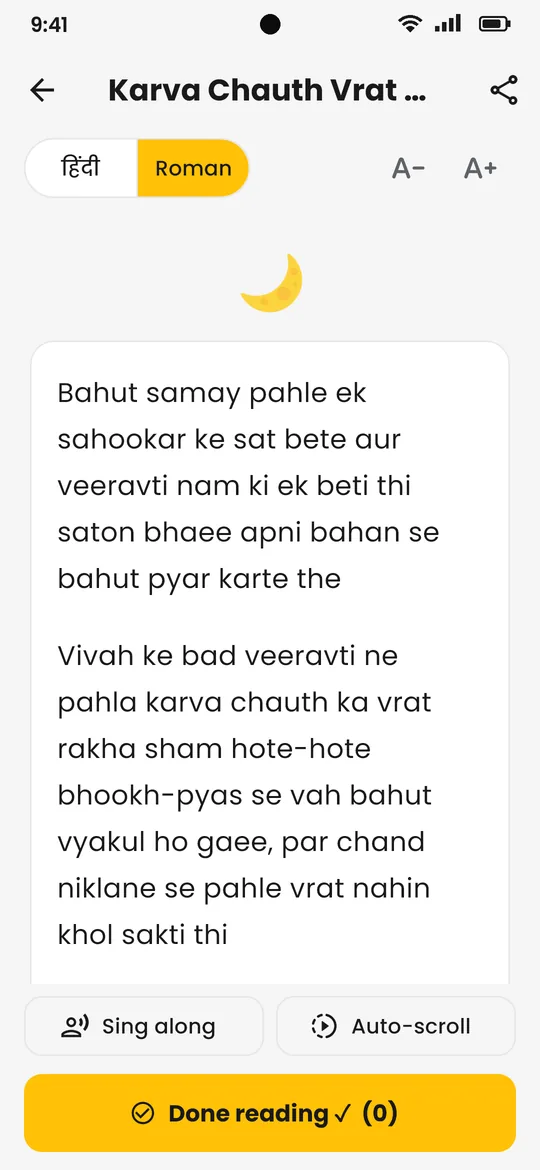
Veeravati, the only sister of seven brothers, grew faint during her first Karva Chauth fast. Her brothers showed her a lamp behind a tree as the moon, she broke her fast, and her husband fell ill and died. She kept the vrat faithfully for a year, and by the grace of Karva Mata and Parvati he was revived. Details on the Karva Chauth page.
Vat Savitri Vrat Katha
Princess Savitri married Satyavan knowing he had one year to live. When Yamraj came for him under a banyan tree, she followed and, through wisdom and devotion, won three boons that restored her husband's life. Kept on Jyeshtha Amavasya in the North and Jyeshtha Purnima in Maharashtra, Gujarat and parts of the South.
Hartalika Teej Vrat Katha
Parvati's father planned to marry her to Vishnu, but she wished only for Shiv. Her friends (alika) took her away (harat) to the forest, where she made a Shivling of sand and fasted without water on Bhadrapad Shukla Tritiya. Shiv accepted her. Married and unmarried women keep it as a nirjala fast.
Ahoi Ashtami Vrat Katha
A mother digging soil for her home accidentally killed a porcupine cub, and afterwards her seven sons died one by one. She prayed to Ahoi Mata with repentance and service, and her sons were restored. Mothers fast on Kartik Krishna Ashtami for their children and open the fast on seeing the stars.
Mahashivratri Vrat Katha
A hunter, lost in the forest at night, climbed a bel tree and stayed awake from fear. Through the night he plucked leaves that fell on a Shivling below, along with drops of water. He had unknowingly done a full night's Shiv puja, and was blessed. The Mahashivratri night vigil follows this story.
Janmashtami, Ganesh Chaturthi and Navratri kathas
- Shri Krishna Janm Katha: Krishna is born at midnight in Kansa's prison; the chains fall open and Vasudev carries him across the Yamuna to Gokul.
- Ganesh Chaturthi Katha: Parvati creates Ganesh to guard her door; Shiv, not knowing him, beheads him, then gives him an elephant's head and makes him first among the gods.
- Navratri Durga Katha: the gods combine their powers to create Durga, who fights Mahishasur for nine days and kills him on the tenth, Vijayadashami.
How to read a katha at home
A katha reading at home is simple: a clean seat, the deity's picture, a lamp, and the family listening together. It takes 10 to 30 minutes depending on the katha.
- Light a lamp and incense before the deity, and place a kalash (water pot) if it is a bigger puja like Satyanarayan.
- Give each listener a few grains of rice (akshat) or a flower to hold.
- One person reads aloud, clearly and without hurry. Others listen without using phones or talking.
- At the end of the katha, everyone offers the rice or flower to the deity and says "Jai" with the deity's name.
- Sing the matching aarti, offer prasad and share it.
Reading alone
If you live alone or are travelling, reading the katha to yourself or listening to it with read aloud is accepted by most traditions. The point is attention. Many working people read the katha in the morning before leaving, then do the aarti in the evening when they open the fast.
Udyapan: closing a series of vrats
After the promised number of weeks, an udyapan is done: a slightly larger puja, the katha, a havan in some families, and food or gifts given to Brahmins, children or the needy, according to the vrat. For example, the Santoshi Mata udyapan traditionally feeds eight boys, and the Solah Somvar udyapan is done on the 17th Monday. Your family priest can guide on details.
Common mistakes and myths about vrats
Fasting is meant to bring discipline and peace, not fear. Some common confusions:
- "If the vrat breaks by mistake, something bad will happen." Kathas themselves show people correcting mistakes and continuing. If a vrat breaks due to illness or accident, ask forgiveness and continue the next week.
- "More hunger means more merit." The texts value restraint of anger and speech as much as restraint of food. A peaceful phalahar vrat is better than an irritable nirjala one.
- "Vrat food can be fried snacks all day." Repeated fried kuttu puris and packaged chips defeat the purpose. Keep it light.
- "Women must keep every vrat." Many vrats are kept by men too, such as Somvar, Mangalvar, Ekadashi and Shivratri. Vrats are a personal choice of devotion.
- "Periods cancel the vrat." Family customs differ widely. Many women continue the fast and hear the katha while skipping the physical puja on those days. Follow your family's view without guilt.
- "Any date is fine for tithi vrats." Ekadashi, Pradosh and Chaturthi follow the lunar calendar and can shift with sunrise. Use the panchang for the correct day.
Regional differences
Karva Chauth is mostly a North and North-West Indian vrat; Hartalika Teej is big in Uttar Pradesh, Bihar, Rajasthan and Maharashtra; Vat Purnima is Maharashtra and Gujarat's form of Vat Savitri; and in Bengal, Monday fasting during Shravan is common among young women. Kathas also differ in small details by region, and all are respected.
Vrat katha in the AstroMilan app
AstroMilan has 18 vrat kathas in Hindi and Roman script: Satyanarayan, Somvar, Mangalvar, Brihaspativar, Santoshi Mata, Shanivar, Ravivar, Ekadashi, Pradosh, Sankashti Chaturthi, Karva Chauth, Vat Savitri, Hartalika Teej, Ahoi Ashtami, Mahashivratri, Janmashtami, Ganesh Chaturthi and Navratri.
- Pick the katha: by weekday, by festival or by name. The Bhakti section also suggests the day's vrat katha.
- Read or listen: use read aloud with your phone's voice, or auto scroll.
- Mark it complete: keep count of the paath you have done.
Festival kathas also appear on their festival pages on the day, and the date of each vrat is in the calendar.
Privacy note
Your vrat and paath records are saved only on your phone. There is no login, and the kathas are built into the app so they work offline.
Questions people ask
Which vrat is best for which day?
The common pattern is Sunday for Surya Dev, Monday for Shiv, Tuesday for Hanuman, Wednesday for Ganesh, Thursday for Vishnu and Brihaspati Dev, Friday for Santoshi Mata or Lakshmi, and Saturday for Shani Dev. People choose the day of the deity they feel close to, or the day their family has always kept.
How many Somvar vrats should be kept?
The Solah Somvar vrat is 16 consecutive Mondays with udyapan on the 17th. Many people instead keep all Mondays of the Sawan month. Some keep Monday vrat for life. Any of these is accepted; choose a number you can keep steadily.
Can I drink water during a vrat?
In most weekday vrats, yes. Water, milk and fruit are allowed in phalahar. Only nirjala fasts, such as Nirjala Ekadashi and, in many homes, Karva Chauth and Hartalika Teej, avoid water too. If you have a health condition, drink water and keep the vrat through puja and katha.
Can we eat salt in a fast?
Regular table salt is avoided in most vrats, but sendha namak (rock salt) is used. Some vrats, such as many Mangalvar and Ravivar vrats, avoid salt altogether in the one meal. Family custom decides the details.
Is the Satyanarayan Vrat Katha included in the app?
Yes, the full Satyanarayan Vrat Katha is included in Hindi and Roman script, along with the Satyanarayan aarti, Jai Lakshmi Ramana. It is commonly done on Purnima, at a griha pravesh or after a wish is fulfilled.
Can the app read the katha aloud?
Yes. The app reads the katha with your phone's text to speech voice and you can follow along, or switch to auto scroll and read yourself. For Hindi reading, your phone needs a Hindi voice installed in its text to speech settings.
Is it necessary to read the katha on a vrat?
Most traditions say yes: the katha is part of the vrat, not an extra. If you cannot read it, listening to someone else read it, or using read aloud, is accepted. The katha reminds you why you are fasting.
What should I do if I break my vrat by mistake?
Do not worry. Ask forgiveness in your prayer, complete the puja and katha that day if possible, and continue the series next week. Many families add one extra week at the end. The kathas themselves show that sincere correction is always accepted.
Can men keep Santoshi Mata or Karva Chauth vrat?
Santoshi Mata vrat is kept by both women and men in many families. Karva Chauth is traditionally kept by wives, but some husbands now fast alongside their wives as a gesture of support. Devotion is not limited by gender.
When is the Ekadashi fast opened?
Ekadashi is opened on the next day, Dwadashi, within a fixed parana window after sunrise. Opening it too late or during Hari Vasar (the first quarter of Dwadashi) is avoided. Sunrise for your town, which sets the window, is in the daily panchang.
Everything in one free app
Kundli Milan, Panchang, Rashifal, Hindu Calendar, Aarti and 20 more tools. No login, and your details never leave your phone.
