
Jaap
Mantra Jaap With a 108 Bead Mala: Rules, Meanings and a Counter
जाप माला
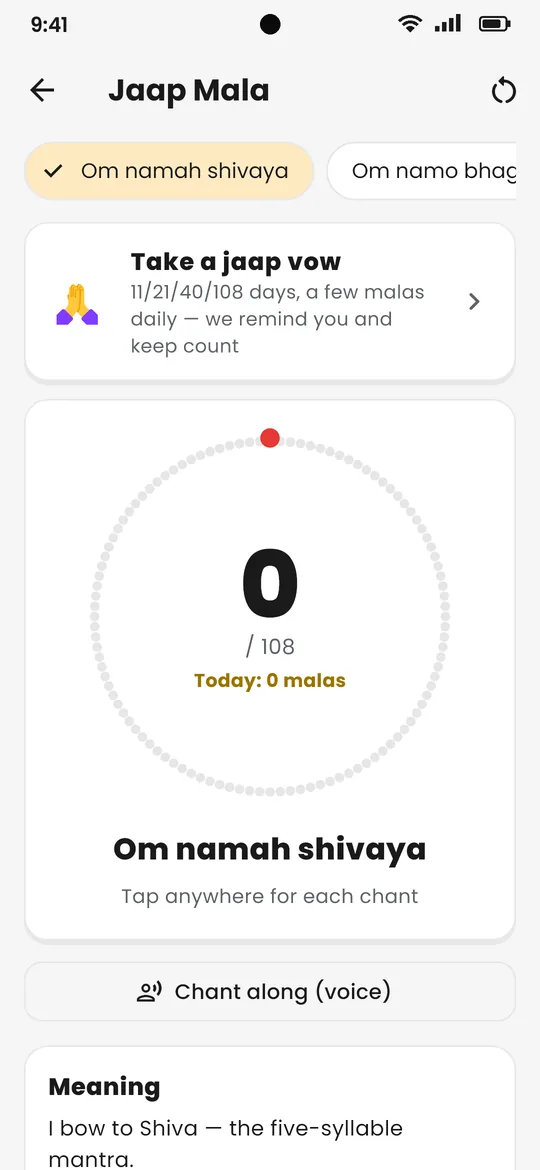
Jaap is the repeated chanting of a mantra or divine name, counted on a mala of 108 beads plus one meru bead. One full round is one mala. A jaap mala counter on the phone lets you count each chant with a tap, keep a daily target and track a sankalp of 11, 21, 40 or 108 days.
Private by design. Your jaap counts and sankalp are stored only on the phone.
On this page
- What jaap is
- Why a mala has 108 beads
- How to do mantra jaap: step by step
- Mantras for jaap and their meaning
- Three great mantras explained
- Choosing a mala: rudraksha, tulsi and others
- Sankalp: taking a jaap vow for 11, 21, 40 or 108 days
- Jaap by weekday and occasion
- Common mistakes and myths
- Jaap mala in the AstroMilan app
- Privacy note
- Questions people ask
What you get
- 108 bead counter with a gentle tap feel
- Mantras with their meaning, such as Om Namah Shivaya and the Gayatri Mantra
- Sankalp for 11, 21, 40 or 108 days with a daily reminder
- Saath jaap: the phone chants with you
How to use it
- Pick a mantraRead its meaning first if you like.
- Tap to countOne tap, one bead. The counter shows malas done today.
- Take a sankalpSet days and malas per day. The app reminds you.
What jaap is
Jaap (japa in Sanskrit) means repeating a mantra or a name of God with attention, a set number of times. It is one of the simplest spiritual practices in Hinduism: no special place, no materials beyond a mala, and it suits any age. The Bhagavad Gita (10.25) has Krishna say that among sacrifices he is japa yajna, the sacrifice of repetition.
A jaap can be a long Vedic mantra like the Gayatri, a short seed (beej) mantra like "Om Gam Ganapataye Namah", or simply a name, such as "Shri Ram Jai Ram Jai Jai Ram" or "Radhe Radhe". The practice is the same: steady repetition, counted so that the mind stays on the mantra and not on keeping track.
Three ways of doing jaap
- Vachik (spoken): chanted aloud so others can hear. Good for beginners and for chanting together.
- Upanshu (whispered): lips move, sound is barely audible. Traditional texts rate it above spoken jaap.
- Manasik (mental): silent, only in the mind. Considered the highest form, but hardest to sustain at first.
Most people start with spoken jaap, move to whispering as the mantra becomes familiar, and use mental jaap while travelling or in a crowd.
What jaap does, in plain words
The mind jumps from thought to thought. Jaap gives it one thing to return to, again and again, for a fixed number of counts. Each time attention wanders, the next bead brings it back. Over weeks, people describe the same changes: they settle faster, feel less scattered in the morning, and find the mantra coming back to them on its own during the day.
The Bhakti tradition adds a second idea: naam (the name) and the named are not separate, so remembering the name is a way of staying close to God. Saints like Tulsidas wrote that in Kaliyug the name alone is enough support. Whether you approach jaap as devotion, as concentration, or both, the method is the same: steady, attentive repetition.
Jaap, kirtan and dhyan
Kirtan is group singing of the names, usually with music and a call and response. Dhyan (meditation) is sitting with a single point of attention, often without words. Jaap sits between them: it uses words like kirtan but is counted and personal like dhyan. Many people do a little of all three.
Why a mala has 108 beads
A standard jaap mala has 108 beads plus one larger bead called the meru or sumeru, which marks the start and end. One pass through 108 beads is one mala. The number 108 has several traditional explanations, all pointing to completeness.
| Explanation | How it makes 108 |
|---|---|
| Nakshatras and padas | 27 nakshatras (lunar mansions) x 4 padas (quarters) = 108 |
| Rashis and grahas | 12 rashis (zodiac signs) x 9 grahas (planets) = 108 |
| Upanishads | The Muktika Upanishad lists 108 Upanishads |
| Names of God | Ashtottara Shatanamavali: 108 names are recited for most deities |
Why count at all
Counting by malas keeps the mind on the mantra, not on the number. Instead of thinking "was that 63 or 64?", you simply move one bead. A fixed number per day also builds a habit: one mala takes about 5 to 10 minutes for a short mantra and 15 to 20 minutes for the Gayatri or Mahamrityunjaya.
Smaller malas
Wrist malas of 27 or 54 beads are also used; four rounds of 27 or two of 54 make one full mala. Counting on finger joints (kar mala) is another old method: the joints of the right hand are touched in a set order with the thumb, which is useful when no mala is at hand.
How to do mantra jaap: step by step
The basic method is the same for any mantra: a clean seat, a fixed time, a sankalp, and steady counting. These steps follow common teaching; your guru or family may add details.
- Choose a time: brahma muhurta (about 90 minutes before sunrise) and the two sandhyas (dawn and dusk) are traditional. A fixed daily time matters more than the exact hour.
- Choose a seat: sit on a mat of wool, cotton or kusha grass, not on the bare floor. Face east or north if possible.
- Prepare: wash hands and face, light a lamp or incense if you like, and keep the deity's picture in front.
- Take the sankalp: silently say your name, the mantra, the number of malas and the purpose, for example "I will chant Om Namah Shivaya one mala daily for 21 days for peace of mind."
- Hold the mala correctly: rest it on the middle finger of the right hand and move the beads towards you with the thumb. Keep the index finger away; tradition links it with ego.
- Chant: one bead per repetition, from the bead next to the meru round to the bead on its other side.
- Do not cross the meru: at the end of one mala, turn the mala around and start the next round in the opposite direction.
- Close: sit quietly for a minute, offer the jaap to the deity with folded hands, and put the mala away in a cloth bag (gaumukhi).
Pace and pronunciation
Speed is less important than clarity. Each syllable should be complete; "Om Namah Shivaya" should not become "Omnamshivay". If you are learning a longer mantra, read its meaning first, then chant it slowly aloud for a few days before speeding up or going silent.
Mantras for jaap and their meaning
AstroMilan includes 16 mantras for jaap, each with its meaning and traditional belief about its benefit. The table lists them with the deity and the day traditionally linked to each.
| Mantra | Deity | Meaning in short | Special day |
|---|---|---|---|
| Om Namah Shivaya | Shiv | I bow to Shiv: the five syllable (panchakshari) mantra | Monday, Pradosh |
| Mahamrityunjaya Mantra | Shiv | Prayer to the three-eyed Lord for freedom from death's bondage (Rigveda 7.59.12) | Monday, times of illness |
| Gayatri Mantra | Savitr (Surya) | We meditate on the radiant Savitr; may it inspire our intellect (Rigveda 3.62.10) | Daily, dawn and dusk |
| Om Suryaya Namah | Surya | Salutations to the Sun, often with morning arghya | Sunday |
| Om Gam Ganapataye Namah | Ganesh | Salutations to Ganapati; "gam" is his seed syllable | Wednesday, Chaturthi |
| Om Ham Hanumate Namah | Hanuman | Salutations to Hanuman; "ham" is his seed syllable | Tuesday, Saturday |
| Om Sham Shanaishcharaya Namah | Shani | Seed mantra of Shani Dev, for patience and discipline | Saturday |
| Om Namo Bhagavate Vasudevaya | Krishna, Vishnu | Salutations to Lord Vasudev: the twelve syllable mantra | Ekadashi, Thursday |
| Om Namo Narayanaya | Vishnu | Salutations to Narayan: the eight syllable mantra | Thursday, Ekadashi |
| Hare Krishna Mahamantra | Krishna, Ram | Calling the Lord by the names Hari, Krishna and Ram | Any day |
| Shri Ram Jai Ram Jai Jai Ram | Ram | The Ram taarak mantra, the simplest name chant | Any day |
| Radhe Radhe | Radha | Shri Radha's name, Braj's most loved chant | Any day |
| Om Aim Saraswatyai Namah | Saraswati | "Aim" is the seed of learning | Before study, Vasant Panchami |
| Om Shreem Mahalakshmyai Namah | Lakshmi | "Shreem" is the seed of abundance | Friday |
| Om Dum Durgayai Namah | Durga | "Dum" is Durga's seed syllable | Navratri |
| Waheguru | Waheguru | Naam simran in the Sikh tradition | Any day |
The benefits described in the app are traditional beliefs, shown as "benefit (belief)". Jaap is a practice of devotion and focus; for health, money or relationship problems it complements, and does not replace, practical help and personal judgement.
Three great mantras explained
Three mantras are chanted more than any other in Indian homes. Knowing their meaning makes the jaap far more alive.
Gayatri Mantra
"Om bhur bhuvah svah, tat savitur varenyam, bhargo devasya dhimahi, dhiyo yo nah prachodayat." It is from the Rigveda (3.62.10), seen by the sage Vishvamitra, in the Gayatri metre of 24 syllables. "Bhur bhuvah svah" names the earth, the space between and the heavens. The prayer itself asks for nothing material: only that the divine light guide our understanding. Traditionally it is chanted at dawn, noon and dusk; many families do one mala in the morning. Rules about who may chant it vary between traditions, and many teachers today welcome all.
Mahamrityunjaya Mantra
"Om tryambakam yajamahe sugandhim pushtivardhanam, urvarukamiva bandhanan mrityor mukshiya maamritat." From the Rigveda (7.59.12), attributed to the sage Vasishtha. Meaning: we worship the three-eyed one, fragrant, who nourishes all; as a ripe cucumber is freed from its vine, may we be freed from death, and not from immortality. The image of the ripe fruit falling easily is one of letting go without fear. Families often take a sankalp of this jaap when someone is unwell, alongside medical care.
Om Namah Shivaya
The panchakshari (five syllable) mantra: Na, Ma, Shi, Va, Ya, with Om before it. It appears in the Shri Rudram of the Yajurveda. It needs no special initiation in most Shaiva traditions and is perhaps the easiest mantra to keep going all day, even silently while walking.
Choosing a mala: rudraksha, tulsi and others
Different malas are traditionally matched with different deities. Any clean mala used with respect works; these are the customs most families follow.
| Mala | Traditionally used for | Note |
|---|---|---|
| Rudraksha | Shiv, Mahamrityunjaya, Hanuman | Usually five-faced (panchmukhi) beads |
| Tulsi | Vishnu, Krishna, Ram, Radha | Common in Vaishnava homes and ISKCON |
| Sphatik (quartz crystal) | Lakshmi, Saraswati, Gayatri | Cool and clear, used for calm jaap |
| Chandan (sandalwood) | Most deities | Red sandalwood for Devi and Ganesh in some traditions |
| Kamalgatta (lotus seed) | Lakshmi | Often used on Diwali and Fridays |
Caring for the mala
- Keep one mala for one mantra if you can; many people keep separate malas for Shiv and Vishnu.
- Store it in a cloth bag, not on the floor, and do not lend it out.
- Some families keep the mala hand inside a gaumukhi bag while chanting, so the counting is private.
- A phone counter is a practical alternative when travelling, at work or in hospital, where a bead mala is not convenient.
Sankalp: taking a jaap vow for 11, 21, 40 or 108 days
A sankalp turns occasional chanting into a practice. You decide the mantra, the number of malas per day and the number of days, and keep it without a break.
Common sankalp lengths
- 11 days: a good first sankalp; long enough to build a habit, short enough to finish.
- 21 days: widely used for Hanuman and Ganesh jaap, and for students before exams.
- 40 days (a mandala): a traditional period for a deeper practice.
- 108 days: a long vow, often taken for a family wish or as thanksgiving.
How many malas a day
One mala a day is plenty for a beginner. Three, five or eleven malas suit those who have more time, such as retired people or anyone in a festival period like Navratri, where the app's Durga mantra note suggests 1 to 11 malas daily. It is better to keep a small vow fully than to break a large one.
Purashcharan: the long traditional practice
Classical texts describe purashcharan, completing a mantra by chanting it one lakh times for each syllable (so 24 lakh for the 24 syllable Gayatri), followed by havan of one tenth of the count. This is a serious practice usually done with a guru's guidance. For most families, a daily mala with a 21 or 40 day sankalp is the practical form.
If you miss a day
Tradition varies. Some restart the sankalp; others add the missed malas the next day. Do what lets you continue with a calm mind. In the app, past days show as done or missed, so you can see your progress honestly.
Jaap by weekday and occasion
Many people pick their mantra by the weekday or by what is happening in the family. This follows the same weekday deity pattern used for aartis and vrats; any mantra can still be chanted any day.
| Day or occasion | Mantra commonly chosen |
|---|---|
| Sunday | Om Suryaya Namah, with water offered to the rising sun, or the Gayatri Mantra |
| Monday, Sawan, Mahashivratri | Om Namah Shivaya, Mahamrityunjaya |
| Tuesday | Om Ham Hanumate Namah, Shri Ram Jai Ram Jai Jai Ram |
| Wednesday, Sankashti | Om Gam Ganapataye Namah |
| Thursday, Ekadashi | Om Namo Bhagavate Vasudevaya, Om Namo Narayanaya |
| Friday, Diwali | Om Shreem Mahalakshmyai Namah |
| Saturday | Om Sham Shanaishcharaya Namah, Hanuman mantra |
| Navratri | Om Dum Durgayai Namah, 1 to 11 malas daily |
| Janmashtami | Hare Krishna Mahamantra, Om Namo Bhagavate Vasudevaya |
Jaap in difficult times
Families often turn to jaap when someone is ill, when a loved one is travelling, or after a loss. The Mahamrityunjaya is chanted for the sick, Ram naam is chanted near the elderly and at the time of death, and Hanuman mantras are chosen for courage before a hard task. In these moments the repetition gives the mind something steady to hold. It sits alongside doctors, planning and support from family, never in place of them.
Jaap with children
Children can start with a short name chant like "Radhe Radhe" or "Shri Ram Jai Ram" for just 11 or 27 counts before school. Letting them tap the counter themselves makes it feel like their own practice. As they grow, the meaning of the Gayatri or Saraswati mantra can be explained before an exam season.
Common mistakes and myths
- "Jaap without a guru has no effect." Name chants like Ram, Radhe, Hare Krishna and Om Namah Shivaya are open to all in most traditions. Some tantric beej mantras are traditionally taken from a guru; if in doubt, ask one.
- "The count must be exact or it is wasted." The count is a support for focus. Losing count once is not a failure; simply continue.
- "Faster is better." Rushing turns the mantra into noise. Slow, clear chanting is preferred in every tradition.
- "Jaap can replace effort or treatment." Jaap brings steadiness and faith. Exams still need study, illness still needs a doctor, and money matters still need planning.
- "Shani or Mangal mantras are to be feared." They are prayers for patience and courage. During Sade Sati, people chant the Shani mantra for discipline, not out of fear.
- "Crossing the meru is fine." Traditionally it is not crossed; the mala is turned back at the meru.
Regional and tradition differences
Vaishnava traditions often chant on tulsi beads and favour the Hare Krishna or Narayan mantras; Shaiva homes use rudraksha and Om Namah Shivaya; Devi worshippers in Bengal and Assam favour Durga and Kali mantras. Sikh naam simran of Waheguru uses a mala (simarna) in many homes. All share the same core: repeated remembrance with love.
Jaap mala in the AstroMilan app
The app's jaap screen works like a mala you tap.
- Pick a mantra: read its meaning and traditional benefit first if you like.
- Tap to count: tap anywhere on the screen; one tap is one bead, with a gentle vibration. Every 108 counts make one mala, and the screen shows malas done today and your total chants.
- Saath jaap: turn on chant along and the phone chants the mantra with its voice while counting automatically.
- Take a sankalp: choose 11, 21, 40 or 108 days and 1, 3, 5 or 11 malas a day, and turn on a daily reminder. A row of circles shows which days are done.
Pair your jaap with the day's aarti, a suvichar for reflection, the vrat katha on fasting days, or check the day's tithi in today's panchang.
Privacy note
Your jaap counts and sankalp are stored only on your phone, and the daily reminder is scheduled on the phone itself. There is no login. More on our privacy page.
Questions people ask
How many times should a mantra be chanted daily?
One mala of 108 is the standard daily practice. Beginners can start with one mala and add more later; many people do 3, 5 or 11 malas on special days like Navratri, Shivratri or Ekadashi. Regularity every day matters more than a large number on one day.
Why does a mala have 108 beads?
The most common explanation is 27 nakshatras times 4 padas, or 12 rashis times 9 grahas, both equal 108. There are also 108 Upanishads in the Muktika list and 108 names recited for most deities. The extra bead, the meru, marks the start and is not counted or crossed.
Which finger is used for jaap mala?
The mala rests on the middle finger of the right hand and the beads are moved with the thumb. The index finger is kept away from the mala because tradition links it with ego and pointing. Some traditions use the ring finger instead of the middle finger.
Can I do jaap without a mala?
Yes. You can count on the finger joints (kar mala) or use a counter. A phone counter like the one in AstroMilan helps at work, while travelling or in hospital, where a bead mala is inconvenient. Mental jaap without counting is also valid, but counting helps keep a daily target.
Can I chant mantras during periods?
Family and regional customs differ. Many traditions and teachers say mental or name jaap, such as Ram or Radhe, can continue at any time, while some families pause formal puja. Follow your family's view or your guru's guidance, without guilt either way.
Can women chant the Gayatri Mantra?
Traditions differ. Some older lineages restricted it, while many modern teachers and organisations encourage everyone to chant it. If your family or guru has a view, follow it; otherwise many people chant it respectfully at dawn and dusk.
What is a jaap sankalp?
A sankalp is a vow to chant a set mantra a fixed number of malas daily for a fixed number of days, such as one mala of Om Namah Shivaya for 21 days. In the app you choose 11, 21, 40 or 108 days and 1, 3, 5 or 11 malas a day, and it tracks each day.
Can I set a daily jaap reminder?
Yes. Take a sankalp and choose the reminder time. The reminder is scheduled on your phone and shows which day of the sankalp it is and the malas set for that day. Days you have already completed do not get a reminder.
Does the app chant the mantra with me?
Yes. Saath jaap uses your phone's text to speech voice to chant the mantra while the counter moves automatically. You can stop the voice any time and go back to tapping.
Which mantra is best for students?
Students commonly chant Om Aim Saraswatyai Namah, the Saraswati mantra for learning, often one mala before study, or the Gayatri Mantra for focus. Om Gam Ganapataye Namah is chanted before exams for a smooth start. These support concentration; regular study is still the main work.
Everything in one free app
Kundli Milan, Panchang, Rashifal, Hindu Calendar, Aarti and 20 more tools. No login, and your details never leave your phone.
