
Shaadi biodata
Marriage biodata maker: the right format, filled in for you
शादी का बायोडाटा
A marriage biodata is a one page profile shared between families when a match is being looked for. It lists personal details, education, work, family background, contact and, in many Hindu families, kundli details such as rashi, nakshatra, gotra and Manglik status, usually with a recent photo.
Private by design. Biodata holds phone numbers, family details and a photo. AstroMilan keeps all of it on your phone and only shares it when you tap Share.
On this page
- What is a marriage biodata?
- Marriage biodata format: the sections to include
- How to write each section well
- Kundli details in a biodata, explained
- Sample marriage biodata format
- Biodata format for boy and for girl
- Hindi or English biodata, and regional styles
- Common biodata mistakes to avoid
- Special cases: second marriage, NRI and late birth details
- After the biodata: next steps in a match
- How to make a marriage biodata in AstroMilan
- Your biodata stays on your phone
- Questions people ask
What you get
- Ready templates that look good on WhatsApp and in print
- Sections for personal, family, education, work and contact details
- Kundli details filled in from your birth profile
- Optional photo, chosen with the Android photo picker
- Export as PDF or image
How to use it
- Start from your profileName and birth details come in automatically.
- Fill the formAdd family, education and work, one short section at a time.
- Pick a template and sharePreview, then send it as a PDF or image.
What is a marriage biodata?
A marriage biodata (also called shaadi biodata or vivah parichay patra) is a short profile of a boy or girl prepared by the family when looking for a match. It is shared with relatives, through community groups and on WhatsApp, and it is usually the first thing the other family reads.
A biodata is different from a job resume. A resume sells skills to an employer. A biodata introduces a person and a family to another family, so it gives equal space to values, background and family details.
What a good biodata does
- Answers the first questions a family asks, so the conversation can move to a meeting.
- Gives accurate birth details, so the other side can do Kundli Milan without calling back.
- Looks neat on a phone screen and also prints well on one A4 page.
From handwritten parichay to WhatsApp
A generation ago, the biodata was a handwritten or typed sheet passed hand to hand by relatives and the family pandit, often folded inside the janam patri. Community magazines and matrimonial columns then printed short versions. Today most biodatas travel as a phone image or PDF, which means the design has to be readable on a small screen: clear headings, a good font size and no crowded borders.
When to make it
Families usually prepare the biodata when they start telling relatives that they are looking for a match. It is worth making it carefully once, saving it, and updating it as details change, instead of rewriting it each time someone asks.
Marriage biodata format: the sections to include
Most Indian biodatas follow the same order of sections. Families read from top to bottom, so put the most asked details first.
| Section | Fields | Tip |
|---|---|---|
| Heading | Blessing line such as Shri Ganeshay Namah, the word Biodata | Optional; use what suits your family |
| Personal | Name, date of birth, time of birth, place of birth, height, religion, caste, gotra | Write height in feet and inches |
| Horoscope | Rashi, nakshatra and charan, Lagna, gan, nadi, Manglik | Take these from the kundli, not from memory |
| Education and career | Highest qualification, college, occupation, employer, annual income | Be specific: degree, company and city |
| Family | Father's name and occupation, mother's name and occupation, siblings | Say whether siblings are married |
| Contact | Address, phone, email | Give a parent's number if you prefer |
| About | Two or three lines about nature, interests and expectations | Keep it honest and short |
A recent, clear photo is usually placed at the top right. One page is the norm; two pages make families skip details.
How to write each section well
Small choices in wording make a biodata easier to read and more trustworthy.
Personal details
Use the full name as on documents. Write the date of birth in a clear form such as 14 February 1997 rather than 14/02/97, which can be misread. Include the time of birth in AM or PM and the town of birth, not just the district. Height, religion and caste are commonly asked; include what your family is comfortable sharing.
Horoscope details
These should come straight from the Janam Kundli. A wrong nakshatra can change the guna milan result by many points, so never guess. If you do not know the birth time, leave the Lagna out rather than writing an approximate one.
Education and career
Write the degree and institution, such as B.Tech, NIT Trichy, or M.Com, Delhi University. For work, give the designation, company type and city, for example Software Engineer at a product company in Pune. Income is often written as a yearly range in lakhs per annum.
Family details
List the father's and mother's names with their occupations, such as retired bank officer or homemaker. For siblings, write something like one elder brother (married, engineer in Bengaluru) and one younger sister (studying). Many families also mention the native place.
About me
Two or three simple lines are enough: your nature, a hobby or two, and what kind of partner and family you hope for. Avoid long lists of adjectives. Specific is better than flowery: likes trekking and cooking reads better than very fun loving and caring.
Partner expectations
If you include expectations, keep them to one line and phrase them as preferences, not conditions. For example: prefers a partner settled in Maharashtra, open to job change. Lists of demands about looks, income or dowry put families off, and dowry is illegal in India under the Dowry Prohibition Act, 1961.
Diet and lifestyle
Many families want to know whether the person is vegetarian, eggetarian or non vegetarian, and whether they drink or smoke. If your template has no separate field, a few words in the about section are enough, such as vegetarian, does not smoke or drink.
Kundli details in a biodata, explained
Many Hindu families read the horoscope section before anything else. Here is what each line means and why it is asked.
| Field | Meaning | Why families ask |
|---|---|---|
| Rashi | The sign the Moon was in at birth | Used for Bhakoot, Graha Maitri, Varna and Vashya in matching |
| Nakshatra and charan | The Moon's star (1 of 27) and its quarter | Used for Tara, Yoni, Gana and Nadi; also the naam akshar |
| Lagna | The sign rising at birth | Needed for the Manglik check from the Lagna |
| Gan | Deva, Manushya or Rakshasa nature | Worth 6 of the 36 gunas |
| Nadi | Adi, Madhya or Antya | Worth 8 gunas; same nadi is Nadi dosha |
| Manglik | Whether Mars is in a Manglik house | Many families prefer Manglik with Manglik |
| Gotra | Paternal lineage from a rishi | Many communities avoid marriage within the same gotra |
With rashi, nakshatra, gan and nadi on the biodata, the other family can see quickly whether major doshas are likely. A full match still needs birth details. If Manglik is marked Yes, it helps to note whether it is cancelled; the Manglik dosh check explains the rules.
Why the birth time belongs on the biodata
The Moon changes nakshatra roughly once a day and the Lagna changes about every two hours. If the other family receives only the date, their pandit may get the wrong nakshatra and therefore a wrong Gana, Nadi or Yoni score. Writing the time and town of birth lets them check the match exactly, without asking.
Gotra and the same gotra rule
Gotra is not calculated from the stars. It comes from the family's paternal line and is filled in by hand. Many North Indian communities avoid marriage within the same gotra, and some also avoid the mother's gotra. Customs differ, so write it if your community considers it.
Sample marriage biodata format
Here is a sample filled biodata in the usual order. The person is fictional; use it as a model for your own wording.
| Field | Example |
|---|---|
| Name | Priya Sharma |
| Date of birth | 14 February 1997 |
| Time of birth | 6:40 AM |
| Place of birth | Jhansi, Uttar Pradesh |
| Height | 5 ft 4 in |
| Religion, caste, gotra | Hindu, Brahmin, Bharadwaj |
| Rashi | Kanya (Virgo) |
| Nakshatra | Hasta, Charan 2 |
| Gan, Nadi | Deva, Adi |
| Manglik | No |
| Education | M.Sc. Chemistry, Bundelkhand University |
| Occupation | Assistant Professor, government college, Gwalior |
| Father | Ramesh Sharma (retired bank manager) |
| Mother | Sunita Sharma (homemaker) |
| Siblings | One elder brother, married, engineer in Noida |
| Contact | Father's mobile number |
| About | Calm, enjoys reading and classical music. Looking for an educated, respectful partner from a family that values both tradition and careers. |
Note how the horoscope lines are taken from the kundli in one block, and how every work and family line says something specific.
Why this sample works
- The date and time are written so they cannot be misread, and the place is a real town, so a pandit can calculate the chart.
- Rashi, nakshatra, gan and nadi are consistent with each other: Hasta nakshatra lies in Kanya rashi, its gana is Deva and its nadi is Adi.
- The job line gives role, type of employer and city in one go.
- The about line is short, personal and polite.
- Contact goes through the father, which many families prefer at the first stage.
Biodata format for boy and for girl
The structure is the same for boys and girls. Families do look at a few points more closely in each case, so it helps to cover them clearly.
For a boy
- Exact designation, employer and city of posting, and whether a transfer or move abroad is likely.
- Annual income as a range, and whether the family owns a house.
- Family set up: joint or nuclear, and where parents will live after marriage.
For a girl
- Education and current work, and plans to continue working after marriage if that matters to her.
- Interests and values in the about section, written in her own voice where possible.
- Preferred city or family type, if any, stated politely.
For both, the kundli section is identical, and the photo should be recent, well lit and simple: a plain background and traditional or smart casual clothes are the usual choice.
Hindi or English biodata, and regional styles
The language of a biodata usually follows the family. Many families make one in Hindi for elders and relatives and one in English for wider sharing.
Hindi biodata
Hindi biodatas use terms such as naam, janm tithi, janm samay, janm sthan, kad, shiksha, vyavsay, pita, mata, bhai bahan, rashi, nakshatra, gan, nadi and manglik. They often begin with a blessing line such as Shri Ganeshay Namah.
Regional customs
- Maharashtra: Marathi biodatas often include devak (family emblem) and kuldaivat (family deity), and the rashi, nakshatra, gan and nadi block is standard.
- Gujarat: families often mention the mosal (maternal family) and native village.
- South India: star (nakshatra) and rasi are the key lines, and some families attach the rasi chart itself. Matching uses poruthams.
- Punjab and Sikh families: kundli details are often left out; family background and education carry more weight.
- Bengal: gotra and gan are commonly listed.
A biodata is used by families of every faith. If your family does not use astrology, simply skip those lines and the blessing.
Common biodata mistakes to avoid
These are the errors that most often lead to awkward follow up calls or lost interest.
- Wrong or missing birth time. Matching depends on it. Check the hospital record or the original janam patri.
- Horoscope details from memory. Rashi by name letter is not the same as the Moon sign. Take it from the kundli.
- Old or heavily filtered photos. They create a poor first impression at the meeting. Use a clear, recent photo.
- Too much text. Two pages of paragraphs are rarely read. Keep it to one page.
- Vague work details. Working in a private company tells the reader nothing. Give role, sector and city.
- Sharing personal numbers widely. Biodatas get forwarded. Consider giving a parent's number and leaving out the full home address.
- Spelling mistakes in names. Read it aloud once before sharing.
Sharing safely
Once a biodata image or PDF is sent on WhatsApp, it can travel far. Share first with trusted relatives and known groups. Keep the email optional and skip anything you would not want strangers to see.
Special cases: second marriage, NRI and late birth details
Some situations need a line or two more than the standard format. Being clear up front saves time for both families.
Second marriage
Mention marital status plainly, such as divorced or widowed, with the year if you wish, and whether there are children. Families appreciate honesty at the start, and it avoids difficult conversations later.
Working or living abroad
For NRI candidates, give the country and city, the type of visa or residency in simple words (for example permanent resident), and how often you visit India. Add the city where the family lives in India, since meetings usually happen there first.
When birth time is not known
Write the date and place and leave the time blank rather than inventing one. The rashi can usually still be found, but the Lagna cannot. Families can then decide whether to match on the Moon sign alone or by name, which is less reliable.
Physical details and health
Height is standard. Weight and complexion are asked in some communities but are increasingly left out. If there is a health condition the other family should know about, many families prefer to mention it at the first meeting rather than in a document that gets forwarded.
After the biodata: next steps in a match
A biodata opens the door. The usual next steps follow a familiar order in most families.
- Both families exchange biodatas and do a kundli match from the birth details.
- If the match looks fine, families talk on phone and arrange a first meeting.
- After the families agree, a date is chosen for the roka, sagai or engagement, and later the wedding, often using a vivah muhurat.
- Many families mark the date on the Hindu calendar and check auspicious days such as Dev Uthani Ekadashi or Vivah Panchami.
Kundli details are traditional guidance. The final decision rests on the two people and their families, after meeting and talking properly.
How to make a marriage biodata in AstroMilan
The biodata maker walks you through one short step at a time.
- Whose biodata: pick a saved birth profile. Name, date, time and place of birth come in automatically, and the rashi, nakshatra with charan, Lagna, gan, nadi and Manglik status are filled in from the birth details. If no birth time is saved, the Lagna is left out.
- Photo and basics: add an optional photo with the Android photo picker, and fill height, religion, caste and gotra.
- Education and work: education, occupation and annual income.
- Family: father's and mother's names with occupations, and siblings.
- Contact: address, phone, an optional email and a short optional about section.
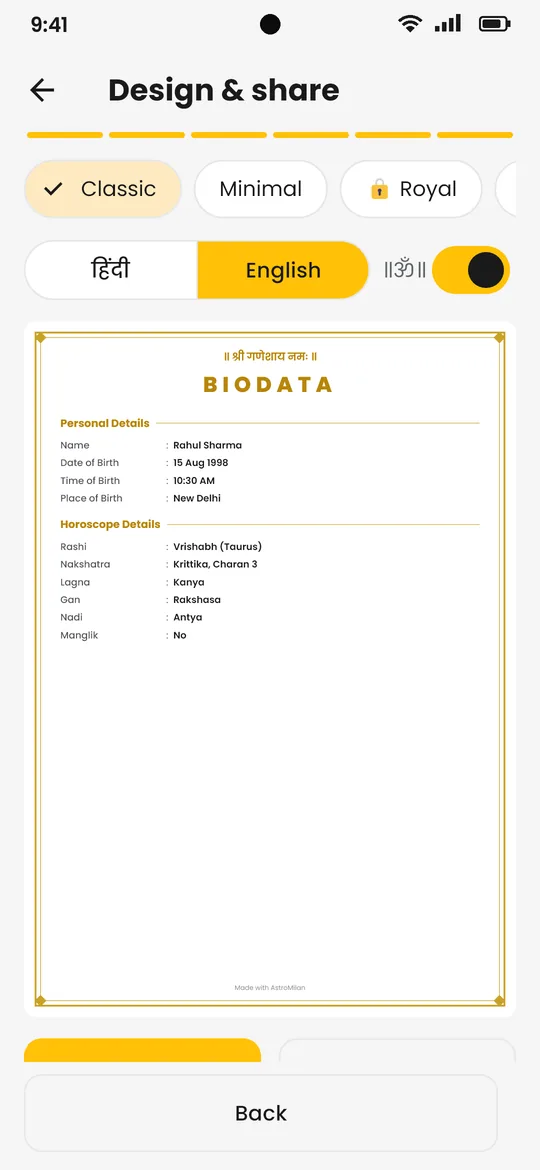
- Design and share: choose a template, print it in Hindi or English, keep or remove the Shri Ganeshay Namah line, then share as a PDF or image.
Classic and Minimal templates are free. Royal and Floral unlock forever after a short ad. Empty fields are simply left off the sheet. The biodata is saved on your phone, so you can edit any field later and share again.
Your biodata stays on your phone
A biodata holds phone numbers, family details and a photo. AstroMilan needs no login, keeps the biodata and photo on your phone, and shares them only when you tap Share. Anonymous usage counts and crash reports go to Google Firebase without personal details. See the privacy page for details.
Questions people ask
What should be written in a marriage biodata?
Include personal details (name, date, time and place of birth, height, religion, caste, gotra), horoscope details (rashi, nakshatra, gan, nadi, Manglik), education and work, family details with parents' occupations and siblings, contact details and a short about section, plus a recent photo. Keep it to one page.
Is the AstroMilan biodata maker free?
Yes. Making, saving, editing and sharing a biodata is free. The Classic and Minimal templates are free to use, and the Royal and Floral templates unlock forever after watching a short ad. There is no login and no subscription.
Can I make a biodata in Hindi?
Yes. When you pick the design, you can print the biodata in Hindi or English. The kundli details such as rashi, nakshatra, gan and nadi appear in the chosen language. Many families make one of each, for elders and for wider sharing.
How do I add kundli details to my biodata?
Pick a birth profile with the date, time and place of birth. AstroMilan calculates the rashi, nakshatra and charan, Lagna, gan, nadi and Manglik status on your phone and fills them in. You do not need to type them, which avoids mistakes. Gotra is entered by hand.
Should I write Manglik in my biodata?
Most Hindu families expect it, because it affects matching. If you are Manglik, it is honest to write it. If the dosha is cancelled by a classical rule, some families add a note saying so. Check your chart in the Manglik dosh check first.
What photo should I use in a marriage biodata?
Use a recent, clear photo with good light, a plain background and a natural expression. Traditional or smart casual clothes are the usual choice. Avoid heavy filters and group photos. In AstroMilan the photo is optional and is picked with the Android photo picker.
Can I edit my biodata after sharing it?
Yes. The biodata is saved on your phone. Open it, change any field, such as a new job or updated height, and share again as a PDF or image. You can also keep more than one biodata, for example for two siblings.
Should I share a biodata as PDF or image?
An image opens instantly in WhatsApp and is easy to view on phones. A PDF prints better and looks more formal when sent by email or forwarded to elders. AstroMilan lets you share in either format from the same biodata.
Is it safe to put my phone number on a biodata?
Biodatas are often forwarded beyond the first person you send them to. Many families give a parent's number instead of the candidate's and leave out the full home address. Share first with trusted relatives and known community groups.
Do I need a kundli to make a biodata?
No. A biodata can be made without any astrology, and many families of all faiths use one. If your family does follow Kundli Milan, the horoscope section saves time for the other side. In AstroMilan these details are worked out from the birth profile, so you do not need a separate kundli in hand.
How long should a marriage biodata be?
One page is the standard. Families read many biodatas, and a single page with clear headings is read fully, while long documents are skimmed. Use short lines instead of paragraphs, keep the about section to two or three sentences, and leave out details that will naturally come up at the first meeting.
Where is my biodata photo stored?
Only in the app's private storage on your phone. AstroMilan has no account and does not upload your biodata or photo. It leaves your phone only when you tap Share and choose where to send it.
Everything in one free app
Kundli Milan, Panchang, Rashifal, Hindu Calendar, Aarti and 20 more tools. No login, and your details never leave your phone.
