
Aarti sangrah
Aarti Sangrah and Chalisa: How to Do Aarti at Home, Day by Day
आरती और चालीसा
Aarti is the closing act of Hindu puja, in which a lit lamp is waved before the deity while a hymn of praise is sung. A chalisa is a 40 verse devotional poem, such as the Hanuman Chalisa by Goswami Tulsidas. Families sing a fixed aarti or chalisa on each weekday and festival.
Private by design. Sing along uses your phone's own text to speech engine. Only the prayer text goes to it, nothing personal.
On this page
- What aarti and chalisa mean
- Every aarti and chalisa in the app
- How to do aarti at home, step by step
- Which aarti on which weekday
- Which aarti on which festival
- Om Jai Jagdish Hare: meaning of the most sung aarti
- Hanuman Chalisa: structure and meaning
- Other popular aartis and their meaning
- Sing along tips for families and beginners
- Common mistakes and myths
- Aarti and chalisa in the AstroMilan app
- Privacy note
- Questions people ask
What you get
- 29 aartis, chalisas and mantras in Hindi and Roman script
- Sing along: each line is read aloud and highlighted
- Auto scroll at your own speed
- Bigger or smaller text
- Mark a paath complete and keep count
- Today's suggested aarti by weekday
How to use it
- Pick an aartiSearch by name or deity, or open the day's suggestion.
- Choose Hindi or Roman scriptMake the text bigger or smaller.
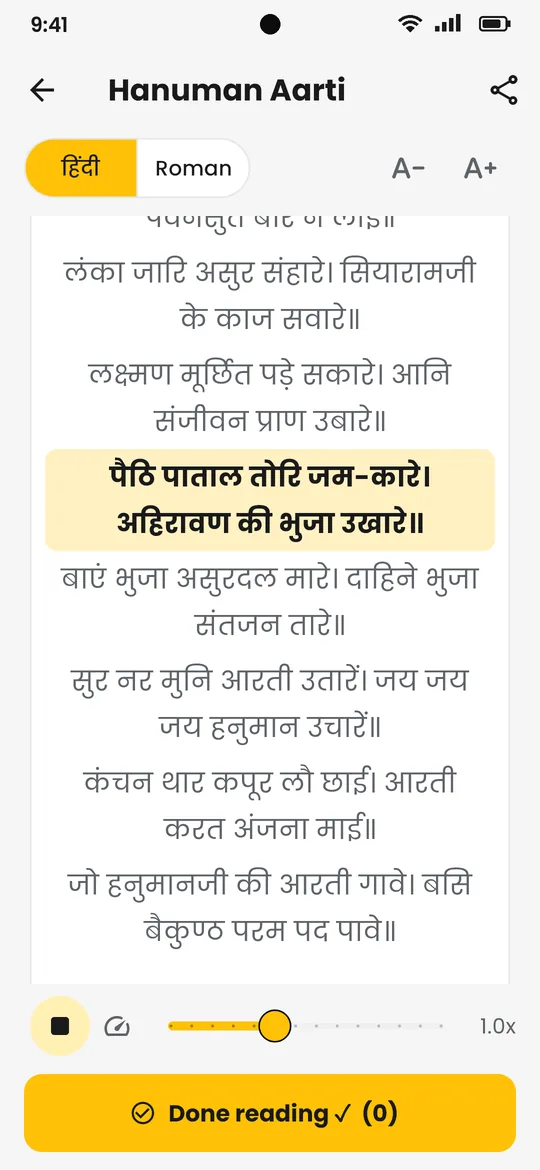
- Tap Saath GaaoFollow the highlighted line, change speed, or use auto scroll.
What aarti and chalisa mean
The word aarti comes from the Sanskrit aratrika, the lamp waved at the end of worship to remove darkness. In daily speech it means both the act of waving the lamp and the song sung while doing it. Aarti usually closes a puja: after the deity has been offered water, flowers, incense and food, the family stands, lights the lamp and sings together.
A chalisa (from chalis, forty) is a devotional poem of forty chaupais (four part verses), usually framed by dohas (couplets) at the start and end. The Hanuman Chalisa is the best known, but there are chalisas for Shiv, Durga, Ganesh, Lakshmi, Shani Dev and many others. A chalisa is recited, not waved with a lamp, and is often read before the aarti.
Aarti, chalisa, stuti and mantra: the difference
- Aarti: a short song with a refrain, sung while the lamp circles the deity. Example: Om Jai Shiv Omkara.
- Chalisa: forty verses praising the deity and telling their stories. Example: Shiv Chalisa.
- Stuti: a hymn of praise, often in Sanskrit or classical Awadhi. Example: Shri Ramchandra Kripalu Bhaju Man by Tulsidas.
- Mantra: a fixed sacred formula repeated many times, usually counted on a mala. Example: the Gayatri Mantra. See our jaap mala page for counting.
Most homes combine them: a chalisa or stuti first, then the aarti, then a short mantra or prayer while offering flowers.
Every aarti and chalisa in the app
- Hanuman Chalisa हनुमान चालीसा
- Om Jai Jagdish Hare ॐ जय जगदीश हरे
- Jai Ganesh Deva जय गणेश देवा
- Om Jai Shiv Omkara ॐ जय शिव ओंकारा
- Jai Ambe Gauri जय अम्बे गौरी
- Om Jai Lakshmi Mata ॐ जय लक्ष्मी माता
- Aarti Kunj Bihari Ki आरती कुंजबिहारी की
- Hanuman Aarti आरती कीजै हनुमान लला की
- Shri Ram Stuti श्रीरामचंद्र कृपालु
- Saraswati Aarti जय सरस्वती माता
- Ganga Aarti ॐ जय गंगे माता
- Shani Dev Aarti जय जय श्री शनिदेव
- Gayatri Mantra गायत्री मंत्र
- Mahamrityunjaya Mantra महामृत्युंजय मंत्र
- Vakratunda Mahakaya वक्रतुण्ड महाकाय
- Satyanarayan Aarti ॐ जय लक्ष्मी रमणा
- Santoshi Mata Aarti जय सन्तोषी माता
- Kali Mata Aarti अम्बे तू है जगदम्बे काली
- Surya Dev Aarti ॐ जय सूर्य भगवान
- Khatu Shyam Aarti ॐ जय श्री श्याम हरे
- Tulsi Mata Aarti जय जय तुलसी माता
- Radha Rani Aarti आरती श्री वृषभानुसुता की
- Govardhan Aarti श्री गोवर्धन महाराज
- Ganesh Aarti (Marathi) सुखकर्ता दुखहर्ता
- Shri Ram Aarti आरती कीजै श्री रघुवर जी की
- Parvati Mata Aarti जय पार्वती माता
- Brihaspati Dev Aarti ॐ जय बृहस्पति देवा
- Shiv Chalisa शिव चालीसा
- Durga Chalisa दुर्गा चालीसा
How to do aarti at home, step by step
A home aarti needs only a lamp, a little ghee or camphor, and a clean place facing the deity. The steps below follow common North Indian household practice; your family custom may differ, and that is fine.
What to keep on the aarti thali
- A diya (lamp) with a cotton wick and ghee or sesame oil, or a camphor (kapur) tablet in a small holder.
- A small bell (ghanti) and, if you have one, a conch (shankh).
- Roli or kumkum, rice grains (akshat), flowers and incense.
- Prasad: fruit, sweets, mishri or whatever your family offers.
- A small bowl of water to sprinkle around the lamp after the aarti.
The sequence
- Prepare: wash hands and face, light incense, and offer flowers and prasad to the deity first.
- Light the lamp: light the diya or camphor. Many families blow the shankh once or ring the bell to begin.
- Start the song: one person holds the thali, the others clap or ring the bell and sing the refrain together.
- Circle the lamp clockwise: a widely taught pattern is four circles at the deity's feet, two at the navel, one at the face, and seven over the whole form. Some families simply make slow clockwise circles for the full song.
- Sprinkle water: after the last line, circle a little water around the lamp to cool it, as a mark of completion.
- Take the aarti: each person passes both palms over the flame and touches them to the eyes and head. The flame is never blown out by mouth.
- Close the puja: many families recite Karpur Gauram, offer flowers (pushpanjali), ask forgiveness for mistakes (kshama prarthana) and share prasad.
The closing verse most families know
The short Sanskrit verse sung after almost every aarti is traditional and public domain: "Karpura gauram karunavataram, sansara saram bhujagendra haram." It describes Shiv as white as camphor, the embodiment of compassion, the essence of the world, wearing the king of serpents as a garland. It is followed by "Sada vasantam hridayaravinde, bhavam bhavani sahitam namami": I bow to Shiv and Bhavani who always live in the lotus of the heart.
Which aarti on which weekday
Each weekday is linked with a planet and a deity, and families choose the aarti and chalisa to match. The table below shows the common North Indian pattern, using the texts available in the app. Regional practice varies, especially for Wednesday and Thursday.
| Day | Graha (planet) | Deity | Aarti or chalisa to sing |
|---|---|---|---|
| Sunday (Ravivar) | Surya | Surya Dev | Om Jai Surya Bhagwan |
| Monday (Somvar) | Chandra | Shiv, Parvati | Om Jai Shiv Omkara, Shiv Chalisa, Jai Parvati Mata |
| Tuesday (Mangalvar) | Mangal | Hanuman | Hanuman Chalisa, Aarti Kije Hanuman Lala Ki |
| Wednesday (Budhvar) | Budh | Ganesh (Krishna in some homes) | Jai Ganesh Deva, Sukhkarta Dukhharta, Aarti Kunj Bihari Ki |
| Thursday (Guruvar) | Brihaspati | Vishnu, Brihaspati Dev | Om Jai Jagdish Hare, Om Jai Brihaspati Deva |
| Friday (Shukravar) | Shukra | Lakshmi, Santoshi Mata, Durga | Om Jai Lakshmi Mata, Jai Santoshi Mata, Jai Ambe Gauri |
| Saturday (Shanivar) | Shani | Shani Dev, Hanuman | Jai Jai Shri Shanidev, Hanuman Chalisa |
Why Hanuman on both Tuesday and Saturday
Tuesday is Mangal's day and Hanuman is worshipped as the deity who calms Mangal. Saturday is Shani's day, and a well known tradition says Hanuman freed Shani Dev from Ravan's captivity, after which Shani promised not to trouble Hanuman's devotees. That is why many people facing Sade Sati or Manglik concerns read the Hanuman Chalisa on both days. This is a matter of faith and comfort, not a fix for any fear.
Om Jai Jagdish Hare on any day
Om Jai Jagdish Hare is addressed to Vishnu as Lord of the universe, so in many North Indian homes and temples it is sung every evening, after the day's own aarti. If you know only one aarti, this is the one most families will join in.
Which aarti on which festival
Festivals have their own aartis, and the right one makes the puja feel complete. Every festival page on AstroMilan lists what to sing on that day; here is a quick reference.
| Festival | Main aarti or chalisa |
|---|---|
| Diwali and Dhanteras | Om Jai Lakshmi Mata, then Jai Ganesh Deva |
| Sharad and Chaitra Navratri | Jai Ambe Gauri, Ambe Tu Hai Jagdambe Kali, Durga Chalisa |
| Mahashivratri, Sawan Mondays | Om Jai Shiv Omkara, Shiv Chalisa |
| Janmashtami | Aarti Kunj Bihari Ki at midnight |
| Ganesh Chaturthi | Jai Ganesh Deva, Sukhkarta Dukhharta (Marathi) |
| Ram Navami, Dussehra | Shri Ramchandra Kripalu, Aarti Kije Shri Raghuvar Ji Ki |
| Hanuman Jayanti | Hanuman Chalisa, Aarti Kije Hanuman Lala Ki |
| Govardhan Puja | Shri Govardhan Maharaj |
| Dev Uthani Ekadashi, Tulsi Vivah | Jai Jai Tulsi Mata, Om Jai Jagdish Hare |
| Vasant Panchami | Jai Saraswati Mata |
| Ganga Dussehra, Kartik Purnima | Om Jai Gange Mata |
| Radhashtami | Aarti Shri Vrishbhanu Suta Ki |
| Purnima Satyanarayan puja | Jai Lakshmi Ramana |
| Makar Sankranti, Chhath | Om Jai Surya Bhagwan |
Two aartis on one day
On Diwali, Lakshmi and Ganesh are worshipped together, so families sing both, usually Ganesh first because he is honoured at the start of any puja. During Navratri many homes sing the Durga aarti morning and evening and add the Kali aarti on Ashtami. There is no rule against singing more than one aarti; the usual order is Ganesh first, then the main deity of the day, then Om Jai Jagdish Hare.
Om Jai Jagdish Hare: meaning of the most sung aarti
Om Jai Jagdish Hare is a Hindi aarti to Vishnu written by Pandit Shardha Ram Phillauri in Punjab in the 1870s. It is now so widely sung that many people think of it as simply "the aarti". Its language is simple Hindi, and its message is surrender and trust.
The opening refrain
"Om jai Jagdish hare, Swami jai Jagdish hare. Bhakt janon ke sankat, kshan mein door kare." Meaning: victory to you, Lord of the world (Jagdish), O Hari. You remove the troubles of your devotees in a moment. The refrain is repeated after every verse, which is why everyone can sing along even without knowing all the lines.
What the verses say
- "Jo dhyave phal pave, dukh binse man ka": whoever meditates on you receives the fruit, and the sorrow of the mind fades.
- "Mat pita tum mere, sharan gahun kiski": you are my mother and father; whose shelter should I seek but yours?
- "Tum puran Paramatma, tum Antaryami": you are the complete Supreme Self and the one who knows what is inside every heart.
- "Tan man dhan sab kuchh hai tera": body, mind and wealth are all yours. The closing idea is that we offer back to God what was already God's.
The aarti moves from asking for help, to seeing God as parent, to understanding God as the inner self, and ends in offering everything. That journey in a few minutes is why it suits the end of any puja.
Hanuman Chalisa: structure and meaning
The Hanuman Chalisa was composed by Goswami Tulsidas in the 16th century in Awadhi, the same language as his Ramcharitmanas. It has two opening dohas, forty chaupais and one closing doha. Reading it takes about eight to ten minutes at a steady pace.
The opening doha
"Shri Guru charan saroj raj, nij manu mukuru sudhari." Meaning: with the dust of my Guru's lotus feet I clean the mirror of my mind. Before praising Hanuman, Tulsidas asks for a clear mind, which is good advice for anyone starting a prayer.
What the forty verses cover
- Verses 1 to 10: Hanuman's qualities. "Jai Hanuman gyan gun sagar" calls him an ocean of wisdom and virtue. His strength, his form and his devotion to Ram are described.
- Verses 11 to 20: his deeds in the Ramayan: finding Sita in Lanka, burning Lanka, bringing the Sanjivani herb to save Lakshman, and swallowing the sun as a child.
- Verses 21 to 30: Hanuman as the doorkeeper of Ram's court and protector of devotees. "Bhoot pishach nikat nahi aave, Mahabir jab naam sunave" says fear and evil cannot come near when his name is spoken.
- Verses 31 to 40: the gifts of his grace. "Nase rog hare sab peera, japat nirantar Hanumat beera" says steady remembrance removes illness and pain. The last verses say whoever reads the chalisa a hundred times is freed from bondage, and Tulsidas signs as "Tulsidas sada Hari chera", ever the servant of Hari.
The closing doha
"Pavan tanay sankat haran, mangal murti roop. Ram Lakhan Sita sahit, hriday basahu sur bhup." Meaning: son of the wind, remover of trouble, form of auspiciousness, please live in my heart along with Ram, Lakshman and Sita. Note that the request is not for wealth or victory but for God to live in the heart.
The chalisa's promises of health and protection are understood by devotees as matters of faith. For any illness, please also see a doctor; prayer and treatment go together.
Other popular aartis and their meaning
Every aarti in the app has a story behind it. Here are short notes on the ones families ask about most. All are traditional texts sung in temples for generations.
Jai Ganesh Deva
The refrain "Jai Ganesh, jai Ganesh, jai Ganesh deva, mata jaki Parvati, pita Mahadeva" introduces Ganesh through his parents. Verses describe his single tusk (ekdant), his four arms, his love for laddus and his mouse vehicle, and ask him to give sight to the blind and children to the childless. It is sung first in almost every puja.
Sukhkarta Dukhharta
This Marathi aarti is credited to Samarth Ramdas in the 17th century and is sung across Maharashtra during Ganeshotsav. "Sukhkarta dukhharta varta vighnachi" means the giver of happiness and remover of sorrow, who ends talk of obstacles. The refrain "Jai dev jai dev jai Mangalmurti" is easy for children to pick up.
Om Jai Shiv Omkara
This aarti praises Shiv along with Brahma and Vishnu, describing their forms: Brahma with four faces, Vishnu with four arms, Shiv with the moon on his head and the Ganga in his hair. It ends with the idea that the three are one, joined in the sound Om.
Jai Ambe Gauri
The Durga aarti sung in Navratri describes her red attire, her lion mount and her victory over Shumbh, Nishumbh, Mahishasur, Chand and Mund. It names her as the mother who protects her children, and is sung with special energy on Ashtami and Navami.
Aarti Kunj Bihari Ki
The Krishna aarti of Braj describes the Lord of the groves of Vrindavan with his flute, peacock feather crown and Radha beside him. The refrain "Aarti kunj bihari ki, Shri Girdhar Krishna Murari ki" names him as the lifter of Govardhan hill.
Shri Ramchandra Kripalu
Strictly a stuti from Tulsidas's Vinaya Patrika, it opens "Shri Ramchandra kripalu bhaju man, haran bhav bhay darunam": O mind, worship the compassionate Shri Ram, who removes the terrible fear of worldly life. Its Sanskritised Awadhi is beautiful but slow; read it once with the meaning before singing.
Sing along tips for families and beginners
Singing together matters more than singing perfectly. These tips help a family or a new learner join the aarti with confidence.
Learning a new aarti
- Read the whole text once with the meaning, so the words make sense.
- Learn the refrain first. In most aartis the refrain carries the tune and comes back after every verse.
- Listen to the line once, then repeat it. The app's sing along reads one line and highlights it, which works like a teacher leading a class.
- Slow the speed for the first week, then bring it to normal.
- Switch to Roman script if Devanagari is hard to read, especially for children abroad.
Pronunciation notes
- Do not rush the long vowels: "Jagdeesh" not "Jagdish" when singing, "Shree" not "Shri".
- Keep the half letters clear: "Paramatma", "Antaryami", "Kripalu".
- In the Hanuman Chalisa, "Shri Guru charan saroj raj" has a soft "j" at the end of saroj, not "saroch".
- If a word is unclear, it is better to sing it softly than to skip the line. Devotion matters more than accent.
Getting children involved
Give children a role: ringing the bell, holding the flower plate, or leading the refrain. Let them read one verse from the screen in a bigger font size. Children who learn the refrain at five often know the whole Hanuman Chalisa by ten, simply by joining every Tuesday. The dharm quiz is another light way to teach them the stories behind the songs.
Common mistakes and myths
Many worries around aarti come from half-remembered rules. Here is what tradition actually says on the common points.
- "Aarti must be at an exact time." Morning (mangala) and evening (sandhya) aartis are customary, and temples have fixed times, but at home the right time is when the family can gather. Some people use the choghadiya or today's panchang for special pujas, not for daily aarti.
- "Anticlockwise is fine." The lamp is circled clockwise (pradakshina direction) in almost every tradition.
- "Blow out the lamp after aarti." Families let it burn out or put it out with a flower or a gentle wave of the hand, never by blowing.
- "Women cannot read the Hanuman Chalisa." This is not a rule found in the chalisa or in Tulsidas's teaching. Women in countless families read it daily.
- "A mistake in the words spoils the puja." Kshama prarthana (prayer for forgiveness) at the end exists for exactly this. Sincerity counts more than perfection.
- "Only Brahmins can lead aarti." Home aarti is led by any family member. Temple customs vary.
Regional differences
In Bengal, the evening sandhya aarti uses a multi-wick lamp, conch and dhunuchi (incense burner) dance during Durga Puja. In Maharashtra, aartis are sung with clapping and cymbals, ending with the Mantrapushpanjali. In Gujarat, the Navratri aarti precedes garba. In South India, the camphor aarti (karpura harathi) is short and often without a long song. All are aarti, simply in different family styles.
Aarti and chalisa in the AstroMilan app
AstroMilan has 23 aartis plus chalisas and mantras in Hindi (Devanagari) and Roman script. The full list appears on this page.
- Pick an aarti: search by name or deity, such as Shiv or Hanuman, or open the "Today's prayer" suggestion, which follows the weekday.
- Choose the script and size: switch between Hindi and Roman and make the text bigger or smaller.
- Tap Saath Gaao (sing along): the phone reads each line aloud and highlights it. Change the speed, or use auto scroll if you prefer to sing yourself.
- Mark it done: tap "paath complete" to keep count of how many times you have read it.
Pair the aarti with a daily suvichar, the matching vrat katha on fasting days, or a few malas on the jaap counter.
Privacy note
The texts are built into the app and work offline. Sing along uses your phone's own text to speech engine; only the prayer text goes to it, nothing personal. Your paath count stays on your phone, and there is no login. Read more on our privacy page.
Questions people ask
Which aarti should be done daily at home?
Most North Indian families sing Om Jai Jagdish Hare every evening because it is addressed to Vishnu as Lord of all. Many add the aarti of the weekday's deity: Shiv on Monday, Hanuman on Tuesday, Ganesh on Wednesday, Vishnu or Brihaspati on Thursday, Lakshmi or Santoshi Mata on Friday and Shani Dev on Saturday. Any one sung with attention is enough.
Who wrote Om Jai Jagdish Hare?
Om Jai Jagdish Hare was written by Pandit Shardha Ram Phillauri, a scholar from Phillaur in Punjab, in the 1870s. It spread through temples and homes so widely that many people believe it is ancient. It is addressed to Vishnu and is sung at the end of many pujas, whatever the main deity.
How many times should Hanuman Chalisa be read?
Once with attention is the basic practice. Many people read it once daily, or seven or eleven times on Tuesday or Saturday. The chalisa itself mentions a hundred readings (jo sat baar paath kar koi), which some devotees complete during special occasions. There is no rule that a smaller number is wrong; regularity matters more than count.
Can Hanuman Chalisa be read at night?
Yes. There is no restriction in the text on reading it at night, and many people read it before sleeping to calm the mind. Tuesday and Saturday evenings are especially common. If you read it at night, sit in a clean place, light a lamp if possible, and read slowly with the meaning in mind.
How many rounds should the aarti lamp make?
A widely taught pattern is four circles near the deity's feet, two at the navel, one at the face and seven around the whole form, always clockwise. Many families simply circle the lamp slowly for the whole song. Both are accepted; follow your family custom if you have one.
What is said after the aarti?
Most families recite Karpur Gauram Karunavataram, a Sanskrit verse to Shiv, then offer flowers and ask forgiveness for any mistakes. After that the aarti is taken by passing the palms over the flame and touching the eyes and head, and prasad is shared.
Is Hanuman Chalisa available in English or Roman script?
Yes. In AstroMilan the Hanuman Chalisa and every other aarti can be shown in Devanagari or in Roman script, with sing along that highlights each line. Roman script helps children and anyone who speaks Hindi but finds Devanagari slow to read.
Do the aartis work without internet?
Yes. All texts are built into the app, and the reading voice works offline once installed, provided your phone has a Hindi voice installed for text to speech. If no Hindi voice is found, the app tells you how to add one in your phone settings.
Are there audio recordings of aartis in the app?
No recorded songs are included. The app reads the text with your phone's voice and highlights each line, so you can follow the words and sing along at your own pace. You can also turn the voice off and use auto scroll.
Which aarti is sung on Diwali?
On Diwali, families sing Jai Ganesh Deva first and then Om Jai Lakshmi Mata during Lakshmi puja in the evening. Many end with Om Jai Jagdish Hare. The Diwali page has the puja timing and steps.
Everything in one free app
Kundli Milan, Panchang, Rashifal, Hindu Calendar, Aarti and 20 more tools. No login, and your details never leave your phone.
