
Live Choghadiya and Hora
Choghadiya today and the hora chart: find a good time right now
चौघड़िया और होरा
Choghadiya is a Vedic time chart that splits the day (sunrise to sunset) and the night (sunset to next sunrise) into eight parts each. Every part is named Amrit, Shubh, Labh, Char, Rog, Kaal or Udveg. Amrit, Shubh and Labh are good for new work, Char suits travel, and Rog, Kaal and Udveg are avoided.
Private by design. Live timings are calculated from your saved place on the phone. No GPS and no tracking.
On this page
- What Choghadiya is and why people check it
- The seven Choghadiyas and their meaning
- How the Choghadiya is calculated
- Day Choghadiya table for all seven weekdays
- Night Choghadiya table
- Hora chart: the planetary hours
- What each hora is good for
- Rahu Kaal, Abhijit and Brahma Muhurat alongside Choghadiya
- Examples: picking a time for everyday tasks
- Common mistakes and myths
- Live Choghadiya and Hora in the AstroMilan app
- Privacy note
- Questions people ask
What you get
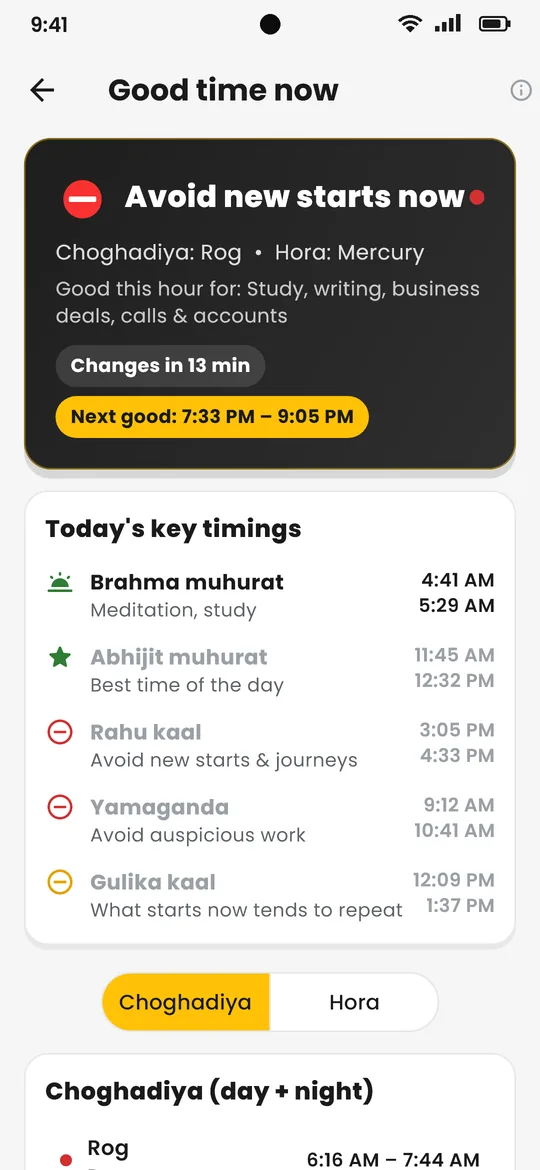
- A live card: good time now, or wait, with a countdown to the change
- Day and night Choghadiya: Amrit, Shubh, Labh, Char, Rog, Kaal, Udveg
- Planetary Hora for every hour and what it suits
- Brahma Muhurat, Abhijit Muhurat, Rahu Kaal, Yamaganda and Gulika
- An optional alert a few minutes before Rahu Kaal starts
How to use it
- Open Shubh SamayIt is on the home screen and in Explore.
- Read the live cardGreen means go, red means wait, and it tells you why.
- Turn on Rahu Kaal alertGet a reminder before Rahu Kaal on the days you choose.
What Choghadiya is and why people check it
Choghadiya is a quick way to judge whether a particular part of the day is good for starting something. The name comes from chau (four) and ghadi, because each slot is roughly four ghadis long. One ghadi is 24 minutes, so on a 12 hour day each Choghadiya lasts about 96 minutes.
The method is especially popular in Gujarat, Rajasthan and Maharashtra, where traders traditionally open new account books, begin a sale or start a journey in a good Choghadiya. Today it is used across India for small daily decisions: when to leave for an interview, when to sign a form, when to bring home a new phone.
Choghadiya versus a full muhurat
Choghadiya answers a small question: is this hour suitable? A full muhurat, such as for a wedding or Dhanteras purchase, also weighs the tithi, nakshatra, yoga and planetary positions. For big life events families use a full muhurat, and Choghadiya is used to pick the exact hour inside a good day. The shubh muhurat finder handles the date and Choghadiya handles the hour.
Regional practice
Choghadiya is part of daily life in Gujarat and Rajasthan, and Gujarati Panchangs print it prominently. Marwari and Gujarati trading families still open the new year's account books, called chopda pujan, in a good Choghadiya on Diwali or the day after.
In South India the same purpose is more often served by Rahu Kaal, Yamaganda, Gulika and Gowri Panchangam, a separate eightfold division with its own names. In North India, families tend to rely on the pandit's muhurat and on Abhijit, while Hora is popular with those who follow planetary timing closely. All of these systems agree on the basic idea of dividing the day into parts and choosing a favourable one.
The seven Choghadiyas and their meaning
There are seven Choghadiya names, each ruled by a planet. Three are auspicious, one is neutral and three are inauspicious.
| Choghadiya | Ruling planet | Nature | Traditionally suits |
|---|---|---|---|
| Amrit | Moon | Best | Any good work, puja, medicine, new beginnings |
| Shubh | Jupiter | Good | Marriage functions, education, religious work |
| Labh | Mercury | Good | Business, trade, study, starting a new job |
| Char (Chal) | Venus | Neutral | Travel, vehicle work, outings |
| Rog | Mars | Avoid | Not for new starts; legal disputes by some traditions |
| Kaal | Saturn | Avoid | Not for new starts; routine and labour work |
| Udveg | Sun | Avoid | Not for new starts; government dealings by some traditions |
Good, neutral and bad in practice
Amrit, Shubh and Labh are the three Choghadiyas people look for when they want to begin something important. Char is fine for travel and for work that involves movement. Rog, Kaal and Udveg are not considered dangerous for ordinary work. They are simply avoided for starting new and important things such as a purchase, an agreement or a journey.
Why the meanings differ slightly between books
Almost every Panchang agrees on which Choghadiyas are good and which are not. The detailed uses, such as Udveg being acceptable for government work or Kaal for collecting dues, vary between regional traditions, so treat those as secondary.
How the Choghadiya is calculated
The calculation uses only three things: your local sunrise, sunset and the weekday.
- Find the length of the day from sunrise to sunset and divide it by 8. Each part is one day Choghadiya.
- Find the length of the night from sunset to the next sunrise and divide it by 8. Each part is one night Choghadiya.
- The first day Choghadiya is set by the weekday, and the rest follow a fixed cycle: Udveg, Char, Labh, Amrit, Kaal, Shubh, Rog, then back to Udveg. The 8th slot of the day repeats the 1st.
- The night uses its own cycle: Shubh, Amrit, Char, Rog, Kaal, Labh, Udveg, with a starting point set by the weekday.
A worked example
Say sunrise is 6:20 and sunset 18:04 on a Monday. The day is 11 hours 44 minutes, so each Choghadiya lasts 88 minutes. Monday starts with Amrit, so Amrit runs 6:20 to 7:48, Kaal 7:48 to 9:16, Shubh 9:16 to 10:44, and so on. In June the same city might have a 13.5 hour day, making every slot over 100 minutes long. This is why a fixed Choghadiya chart with 90 minute slots is only approximate.
Day Choghadiya table for all seven weekdays
This is the sequence of the eight day Choghadiyas, from sunrise to sunset, for each weekday. The clock times depend on your sunrise, but the order is always the same.
| Slot | Sun | Mon | Tue | Wed | Thu | Fri | Sat |
|---|---|---|---|---|---|---|---|
| 1 | Udveg | Amrit | Rog | Labh | Shubh | Char | Kaal |
| 2 | Char | Kaal | Udveg | Amrit | Rog | Labh | Shubh |
| 3 | Labh | Shubh | Char | Kaal | Udveg | Amrit | Rog |
| 4 | Amrit | Rog | Labh | Shubh | Char | Kaal | Udveg |
| 5 | Kaal | Udveg | Amrit | Rog | Labh | Shubh | Char |
| 6 | Shubh | Char | Kaal | Udveg | Amrit | Rog | Labh |
| 7 | Rog | Labh | Shubh | Char | Kaal | Udveg | Amrit |
| 8 | Udveg | Amrit | Rog | Labh | Shubh | Char | Kaal |
How to use the day table
Find today's column, count which slot you are in from sunrise, and read the name. On a Thursday with sunrise at 6:00 and 90 minute slots, the fifth slot, from 12:00 to 13:30, is Labh, a good time for business. But Thursday's Rahu Kaal is the 6th eighth of the day, 13:30 to 15:00, which falls on Amrit. Many families skip a good Choghadiya when it overlaps Rahu Kaal, which is why it helps to see both together.
Night Choghadiya table
The night Choghadiyas run from sunset to the next sunrise and follow a different starting point for each weekday. The weekday here is the Panchang day, so the night after Sunday's sunset is still Sunday night.
| Slot | Sun | Mon | Tue | Wed | Thu | Fri | Sat |
|---|---|---|---|---|---|---|---|
| 1 | Shubh | Char | Kaal | Udveg | Amrit | Rog | Labh |
| 2 | Amrit | Rog | Labh | Shubh | Char | Kaal | Udveg |
| 3 | Char | Kaal | Udveg | Amrit | Rog | Labh | Shubh |
| 4 | Rog | Labh | Shubh | Char | Kaal | Udveg | Amrit |
| 5 | Kaal | Udveg | Amrit | Rog | Labh | Shubh | Char |
| 6 | Labh | Shubh | Char | Kaal | Udveg | Amrit | Rog |
| 7 | Udveg | Amrit | Rog | Labh | Shubh | Char | Kaal |
| 8 | Shubh | Char | Kaal | Udveg | Amrit | Rog | Labh |
When night Choghadiya matters
Night Choghadiya is used for evening pujas, Lakshmi puja timings on Diwali, late night travel and for events such as weddings that often take place after sunset. On Diwali night, many families look for a Labh, Shubh or Amrit Choghadiya that also falls in the Pradosh Kaal or Sthir Lagna before beginning Lakshmi puja.
After midnight
Between midnight and sunrise, the night Choghadiya still belongs to the previous Panchang day. If it is 2 am on a Wednesday by the clock, you read the Tuesday night column.
Hora chart: the planetary hours
Hora is a second, finer clock that many people read alongside Choghadiya. The daytime and the night are each split into 12 equal horas, and each hora is ruled by one of the seven visible planets. With a 12 hour day each hora is exactly 60 minutes, which is why it is often called the planetary hour.
The rule behind the order
The first hora after sunrise belongs to the lord of the weekday: Sun on Sunday, Moon on Monday, Mars on Tuesday, Mercury on Wednesday, Jupiter on Thursday, Venus on Friday and Saturn on Saturday. Each next hora follows the classical order of planetary speed, slowest to fastest: Saturn, Jupiter, Mars, Sun, Venus, Mercury, Moon, then repeating. After 24 horas the cycle lands exactly on the next weekday's lord, which is in fact how the order of the weekdays came about.
| Day hora | Sun | Mon | Tue | Wed | Thu | Fri | Sat |
|---|---|---|---|---|---|---|---|
| 1 | Sun | Moon | Mars | Mercury | Jupiter | Venus | Saturn |
| 2 | Venus | Saturn | Sun | Moon | Mars | Mercury | Jupiter |
| 3 | Mercury | Jupiter | Venus | Saturn | Sun | Moon | Mars |
| 4 | Moon | Mars | Mercury | Jupiter | Venus | Saturn | Sun |
| 5 | Saturn | Sun | Moon | Mars | Mercury | Jupiter | Venus |
| 6 | Jupiter | Venus | Saturn | Sun | Moon | Mars | Mercury |
| 7 | Mars | Mercury | Jupiter | Venus | Saturn | Sun | Moon |
Horas 8 to 12 repeat horas 1 to 5. The first night hora continues the same cycle, so Sunday night begins with a Jupiter hora, Monday night with Venus, Tuesday night with Saturn, Wednesday night with the Sun, Thursday night with the Moon, Friday night with Mars and Saturday night with Mercury.
What each hora is good for
Each planet's hora is traditionally matched to the kind of work that planet signifies. Jupiter, Venus, Mercury and the Moon are counted as benefic horas. The Sun, Mars and Saturn horas are used for specific tasks rather than general new starts.
- Sun hora: government work, interviews, meeting seniors or officials.
- Moon hora: travel, meeting people, home and family matters.
- Mars hora: property matters, sports, tasks that need courage.
- Mercury hora: study, writing, business deals, phone calls and accounts.
- Jupiter hora: worship, seeking advice, money and bank work, auspicious beginnings.
- Venus hora: love, shopping, clothes and jewellery, art and music.
- Saturn hora: finishing pending work and hard labour; new starts are best avoided.
Combining Choghadiya and Hora
The strongest small window is one where both agree: a Labh or Amrit Choghadiya that coincides with a Jupiter, Mercury or Venus hora, outside Rahu Kaal. For example, if you want to submit a business proposal, a Labh Choghadiya during a Mercury hora is a classic choice. If the Choghadiya is good but the hora is Saturn, many people simply wait for the next hora.
Rahu Kaal, Abhijit and Brahma Muhurat alongside Choghadiya
Choghadiya does not stand alone. Three other daily windows change how you should read it.
Rahu Kaal, Yamaganda and Gulika
Rahu Kaal is the 8th eighth of the day on Sunday, the 2nd on Monday, the 7th on Tuesday, the 5th on Wednesday, the 6th on Thursday, the 4th on Friday and the 3rd on Saturday. Yamaganda and Gulika Kaal are other eighths of the day treated similarly. When any of these overlaps a good Choghadiya, cautious families wait until it ends. You can read more on the aaj ka Panchang page.
Abhijit Muhurat
Abhijit is the 8th of 15 daytime muhurtas, centred on local noon. It is considered good enough to override many small defects, and is often used when no good Choghadiya fits your schedule. Tradition does not use Abhijit on Wednesdays.
Brahma Muhurat
Brahma Muhurat runs from about 96 to 48 minutes before sunrise. It is used for prayer, meditation, study and jaap, not for worldly starts, and it is good whatever the night Choghadiya says.
Examples: picking a time for everyday tasks
Here is how the tables work for real situations. All examples assume a model day with sunrise at 6:00 and sunset at 18:00, so check your own times before using them.
Opening a new shop counter on a Wednesday
Wednesday's day Choghadiyas run Labh, Amrit, Kaal, Shubh, Rog, Udveg, Char, Labh. Labh (6:00 to 7:30) and Amrit (7:30 to 9:00) are both strong for business, and Rahu Kaal on Wednesday is the 5th eighth, 12:00 to 13:30, well away from them. Abhijit is not used on Wednesday, so an early morning opening in Labh or Amrit is the classic choice. Shubh from 10:30 to 12:00 is a good later option.
Leaving for a long journey on a Friday
Friday begins with Char (6:00 to 7:30), which is the traditional Choghadiya for travel, followed by Labh and Amrit. Friday's Rahu Kaal is the 4th eighth, 10:30 to 12:00, which falls on Kaal anyway. Leaving between 6:00 and 10:30 keeps you in Char, Labh or Amrit. Tradition also notes disha shool, a direction to avoid on each weekday; on Friday it is west.
Signing a document on a Saturday
Saturday's day starts with Kaal, then Shubh (7:30 to 9:00), but Saturday's Rahu Kaal is the 3rd eighth, 9:00 to 10:30, which covers Rog. Shubh from 7:30 to 9:00 is clean. Later, Labh (13:30 to 15:00) and Amrit (15:00 to 16:30) are good, and if the hora at that time is Mercury or Jupiter, so much the better.
Evening puja on a Monday
Monday night opens with Char, then Rog, Kaal, Labh. Sunset is 18:00 and the night Choghadiya is 90 minutes in our model, so Labh runs from 22:30 to midnight. For a regular evening aarti, though, the Choghadiya does not matter: daily worship is done at its usual time. The Choghadiya becomes relevant only when you are starting a special anusthan or sankalp.
Common mistakes and myths
Choghadiya is simple, which also makes it easy to misread. These are the errors pandits see most often.
- Using a fixed 90 minute chart: Printed charts assume 6 am sunrise and 6 pm sunset. In real life the slot length changes every day and differs between cities.
- Starting the day at midnight: Choghadiya days start at sunrise. Early morning before sunrise still belongs to the previous night.
- Ignoring Rahu Kaal: A good Choghadiya inside Rahu Kaal is usually skipped for important starts.
- Using Choghadiya for a wedding date: Choghadiya picks an hour, not a day. Weddings and griha pravesh need the full muhurat rules for tithi, nakshatra and month.
- Fear of Rog or Kaal: These periods are not unlucky for ongoing work, meals, travel already planned or daily duties. They are only avoided for important new beginnings.
Choghadiya and Hora are traditional guidance for timing small tasks. They are not a substitute for preparation, and important decisions still need your own judgement.
Live Choghadiya and Hora in the AstroMilan app
AstroMilan's Shubh Samay screen (Abhi Shubh Samay) answers one question: is now a good time? It reads the running Choghadiya and Hora for your saved place and shows a live card. Green means go, red means wait, and it tells you why, with a countdown to the next change and the next good window that avoids Rahu Kaal.
- Day and night Choghadiya calculated from your own sunrise and sunset.
- Planetary Hora for every hour with what it suits.
- Brahma Muhurat, Abhijit Muhurat, Rahu Kaal, Yamaganda and Gulika Kaal.
- An optional alert a few minutes before Rahu Kaal on the days you choose.
Open Shubh Samay from the home screen or Explore. The running hora is also used by the Haan ya Na game. For vrats and festival timings, see the Hindu calendar.
Privacy note
There is no login. Live timings are calculated on your phone from the place you picked from the built in list of over 5.5 lakh Indian towns and villages, and the app does not use GPS. Anonymous usage counts and crash reports go to Google Firebase without personal details.
Questions people ask
What is the Choghadiya now?
It depends on your local sunrise, sunset and the weekday. Find how many eighths of the day (or night) have passed and read today's column in the table above. The easier way is to open Shubh Samay in AstroMilan, which shows the running Choghadiya for your place and when the next one begins.
Which Choghadiya is best for buying a vehicle?
Amrit, Shubh and Labh are good for any purchase. Char, ruled by Venus and linked to movement, is also traditionally accepted for vehicles and travel. Avoid Rog, Kaal and Udveg, and check that the slot does not overlap Rahu Kaal. For choosing the date itself, use the Vahan option in the muhurat finder.
How long is one Choghadiya?
One eighth of the daytime or night. With a 12 hour day it is 90 minutes. In summer in North India, when days run about 14 hours, a day Choghadiya is around 105 minutes and a night Choghadiya around 75 minutes. In winter the opposite is true.
What is the difference between Choghadiya and Hora?
Choghadiya divides the day and the night into 8 parts each, with seven names like Amrit and Labh. Hora divides them into 12 parts each, each ruled by a planet in the order Saturn, Jupiter, Mars, Sun, Venus, Mercury, Moon. Choghadiya says if a slot is good; Hora says what kind of work it suits.
Is Char Choghadiya good or bad?
Char, also written Chal, is neutral. It is considered good for travel, vehicles and work that involves movement, and acceptable for routine tasks. For starting something important, most people prefer Amrit, Shubh or Labh.
Can I do puja in Rahu Kaal or a bad Choghadiya?
Regular daily puja, prayer and jaap are not stopped for Rahu Kaal or for Rog, Kaal and Udveg. Some traditions even recommend Durga worship during Rahu Kaal. The avoidance applies to starting new worldly ventures such as purchases, agreements and journeys.
Which hora is good for an interview?
Tradition links interviews and meetings with seniors to the Sun hora, and business discussions to the Mercury hora. A Jupiter hora is considered generally favourable for any important start. Combine it with a good Choghadiya outside Rahu Kaal for the best window.
Is Choghadiya the same in every city?
The order is the same for a given weekday, but the clock times are not. Every slot is calculated from local sunrise and sunset, which can differ by over an hour across India. That is why AstroMilan calculates Choghadiya for the exact town or village you choose.
Which Choghadiya is used for Diwali Lakshmi puja?
Families usually choose a Labh, Shubh or Amrit Choghadiya in the evening or night of Diwali, often combined with Pradosh Kaal and a fixed (Sthir) lagna. Exact timings change every year and by city. See the Diwali page for the festival details.
Why does Monday start with Amrit Choghadiya?
The first day Choghadiya of each weekday is fixed by tradition, and the rest follow the cycle Udveg, Char, Labh, Amrit, Kaal, Shubh, Rog. Amrit is ruled by the Moon, and Monday (Somvar) is the Moon's day, so the day opens with Amrit. In the same way Sunday opens with Udveg, ruled by the Sun.
What is aaj ka shubh Choghadiya?
Aaj ka shubh Choghadiya means today's auspicious slots: every Amrit, Shubh and Labh Choghadiya of the day and night. Look up today's weekday column in the tables above, then convert slots to clock times using your sunrise and sunset. AstroMilan lists them with exact times and marks the next good one that is clear of Rahu Kaal.
Do I need internet to see today's Choghadiya?
No. AstroMilan calculates Choghadiya, Hora and Rahu Kaal on the phone, and the place list is inside the app, so it works offline. Internet is only used for ads and crash reports.
Everything in one free app
Kundli Milan, Panchang, Rashifal, Hindu Calendar, Aarti and 20 more tools. No login, and your details never leave your phone.
