
36 Guna Milan
Kundli Milan: how 36 guna matching works, koot by koot
कुंडली मिलान · 36 गुण
Kundli Milan is the Vedic method of matching the birth charts of a boy and a girl before marriage. The common form, Ashtakoot Guna Milan, compares their Moon signs and Moon nakshatras across eight koots worth 36 points in total. Traditionally 18 or more gunas is accepted, with Nadi, Bhakoot and Manglik checks read alongside.
Private by design. Both birth details stay on your phone. The match is calculated on the device, so nobody else sees whose kundli you matched.
On this page
- What is Kundli Milan?
- The 8 koots and their points
- Each koot explained, with the scoring rules
- Nakshatra table for Gana, Nadi and Yoni
- How to read your guna score
- Nadi dosha and Bhakoot dosha: when they are cancelled
- Manglik dosha in Kundli Milan
- A worked example of Kundli Milan
- Common mistakes and myths about guna milan
- Regional differences: Ashtakoot and Dashakoot
- How to do Kundli Milan in the AstroMilan app
- Privacy of your match
- Questions people ask
What you get
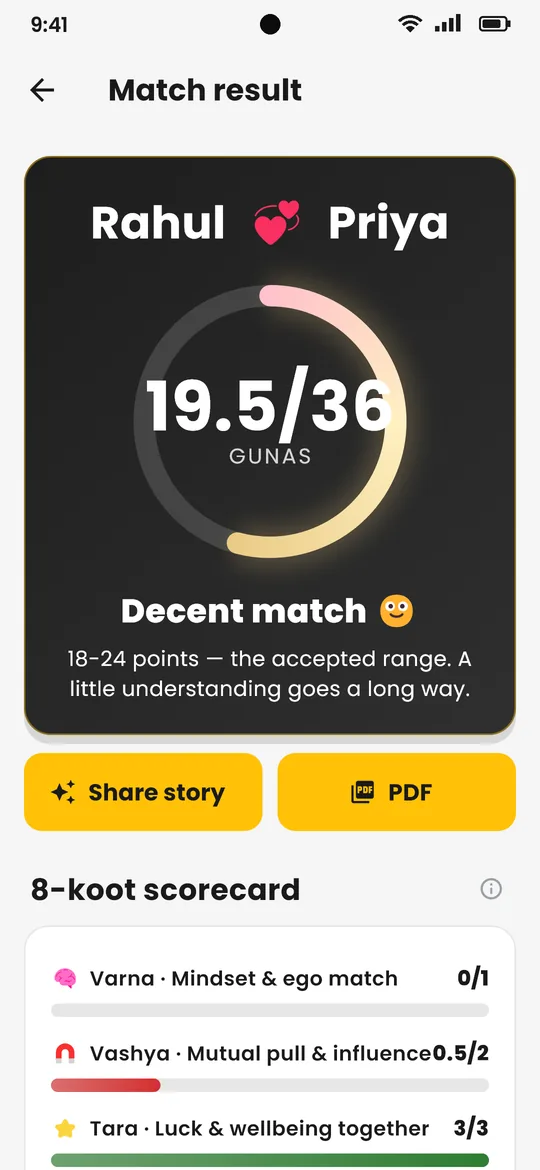
- Total guna out of 36 with a clear verdict for the match
- Score for each of the 8 koots: Varna, Vashya, Tara, Yoni, Graha Maitri, Gana, Bhakoot and Nadi
- Manglik check for both people, with cancellation rules explained
- Nadi dosha and Bhakoot dosha in plain Hindi, Hinglish or English
- A story card to share and a detailed PDF report
- Partner invite code: send your code and your partner can match in one tap
How to use it
- Add the boy's detailsName, date of birth, time of birth and place. Pick any town or village in India from the built in list.
- Add the girl's detailsThe same four details. If the time is not known, use your best guess and treat the result as approximate.
- Read the scorecardSee the total, each koot and the dosha checks. Tap any koot for its meaning.
- Share or saveSend a story card on WhatsApp or save the full PDF report for the family.
What is Kundli Milan?
Kundli Milan, also called Guna Milan or horoscope matching, is the traditional check families do before fixing a marriage. The pandit compares the janam kundli (birth chart) of the boy and the girl and looks for harmony in nature, health, family life and children.
The most widely used method in North and Central India is Ashtakoot Milan, the matching of eight koots (categories). Each koot carries fixed points, and together they add up to 36. In South India a related system called Dashakoot or Porutham uses ten checks, which we cover later on this page.
Why the Moon is the base of matching
Ashtakoot Milan uses only two facts from each chart: the Moon sign (chandra rashi) and the Moon nakshatra (lunar mansion). In Jyotish the Moon stands for the mind, feelings and day to day temperament, which is what two people actually live with after marriage. That is why the match is read from the Moon and not from the Sun sign used in western horoscopes.
What you need for a proper match
You need the date, time and place of birth of both people. The Moon moves about 13 degrees a day and changes nakshatra roughly every 24 hours, so the date alone is not always enough. The time pins down the exact nakshatra, and the place gives the correct time zone and Lagna for the Manglik check. If you only have names, a love calculator can be fun, but it is not a kundli match.
The 8 koots and their points
Every koot looks at one side of married life and has a maximum score. The higher points go to koots that tradition treats as more serious, which is why Nadi (8) and Bhakoot (7) matter so much.
| Koot | Max points | Based on | What it looks at |
|---|---|---|---|
| Varna | 1 | Moon sign | Temperament, ego and spiritual outlook |
| Vashya | 2 | Moon sign | Mutual attraction and who influences whom |
| Tara | 3 | Nakshatra | Luck and wellbeing in each other's company |
| Yoni | 4 | Nakshatra | Physical and intimate compatibility |
| Graha Maitri | 5 | Moon sign lord | Friendship and mental wavelength |
| Gana | 6 | Nakshatra | Basic nature: Deva, Manushya or Rakshasa |
| Bhakoot | 7 | Moon sign distance | Family welfare, finances and growth |
| Nadi | 8 | Nakshatra | Health and progeny (children) |
| Total | 36 |
Notice that four koots come from the Moon sign and four from the nakshatra. Two people with the same rashi but different nakshatras can get very different scores, which is why exact birth time matters.
Each koot explained, with the scoring rules
Here is how a careful pandit scores each koot. These are the standard North Indian rules, the same ones AstroMilan uses.
1. Varna (1 point)
Each rashi has a varna: Kark, Vrishchik and Meen are Brahmin; Mesh, Simha and Dhanu are Kshatriya; Vrishabh, Kanya and Makar are Vaishya; Mithun, Tula and Kumbh are Shudra. Today this is read as a measure of outlook and ego, not caste. The boy gets the 1 point when his varna is equal to or higher than the girl's.
2. Vashya (2 points)
Rashis fall into five groups: Chatushpada (four legged: Mesh, Vrishabh, second half of Dhanu, first half of Makar), Manava (human: Mithun, Kanya, Tula, Kumbh, first half of Dhanu), Jalachara (water: Kark, Meen, second half of Makar), Vanachara (wild: Simha) and Keeta (insect: Vrishchik). Same group gives 2 points, and other pairs get 1, half or 0 depending on how naturally one group yields to the other.
3. Tara (3 points)
Count the nakshatras from the girl's to the boy's and divide by 9. A remainder of 3 (Vipat), 5 (Pratyari) or 7 (Vadha) is unlucky. The count is done both ways, and each direction that is not unlucky earns 1.5 points.
4. Yoni (4 points)
Each nakshatra has an animal symbol, from 14 animals in all. Same animal gives 4 points, friendly animals 3 or 2, and natural enemies 0. The enemy pairs are Horse and Buffalo, Elephant and Lion, Sheep and Monkey, Serpent and Mongoose, Dog and Deer, Cat and Rat, and Cow and Tiger.
5. Graha Maitri (5 points)
This looks at the lords of the two Moon signs. If the same planet rules both signs, or the two lords are mutual friends, the score is 5. One friend and one neutral gives 4, both neutral gives 3, friend and enemy gives 1, neutral and enemy gives half a point, and mutual enemies give 0.
6. Gana (6 points)
The 27 nakshatras are split equally into Deva (gentle), Manushya (human, balanced) and Rakshasa (intense, independent). Same gana scores 6. A Deva boy with a Manushya girl scores 6, the reverse scores 5. Deva with Rakshasa scores 1, and Manushya with Rakshasa scores 0.
7. Bhakoot (7 points)
Count the Moon signs from one partner to the other and back. If the pair of counts is 2 and 12, 5 and 9, or 6 and 8, the Bhakoot score is 0 and this is called Bhakoot dosha. All other positions, including the same sign, give the full 7.
8. Nadi (8 points)
Every nakshatra belongs to one of three nadis: Adi, Madhya or Antya. If both partners have different nadis, the score is 8. If they share a nadi, the score is 0 and this is Nadi dosha, the most discussed dosha in Indian matchmaking.
Nakshatra table for Gana, Nadi and Yoni
Three koots come straight from the Moon nakshatra. Use this table to see where your own nakshatra falls. You can find your nakshatra in your Janam Kundli.
| Nakshatra | Gana | Nadi | Yoni |
|---|---|---|---|
| Ashwini | Deva | Adi | Horse |
| Bharani | Manushya | Madhya | Elephant |
| Krittika | Rakshasa | Antya | Sheep |
| Rohini | Manushya | Antya | Serpent |
| Mrigashira | Deva | Madhya | Serpent |
| Ardra | Manushya | Adi | Dog |
| Punarvasu | Deva | Adi | Cat |
| Pushya | Deva | Madhya | Sheep |
| Ashlesha | Rakshasa | Antya | Cat |
| Magha | Rakshasa | Antya | Rat |
| Purva Phalguni | Manushya | Madhya | Rat |
| Uttara Phalguni | Manushya | Adi | Cow |
| Hasta | Deva | Adi | Buffalo |
| Chitra | Rakshasa | Madhya | Tiger |
| Swati | Deva | Antya | Buffalo |
| Vishakha | Rakshasa | Antya | Tiger |
| Anuradha | Deva | Madhya | Deer |
| Jyeshtha | Rakshasa | Adi | Deer |
| Mula | Rakshasa | Adi | Dog |
| Purva Ashadha | Manushya | Madhya | Monkey |
| Uttara Ashadha | Manushya | Antya | Mongoose |
| Shravana | Deva | Antya | Monkey |
| Dhanishta | Rakshasa | Madhya | Lion |
| Shatabhisha | Rakshasa | Adi | Horse |
| Purva Bhadrapada | Manushya | Adi | Lion |
| Uttara Bhadrapada | Manushya | Madhya | Cow |
| Revati | Deva | Antya | Elephant |
The Nadi column follows a zig zag pattern: Adi, Madhya, Antya, Antya, Madhya, Adi, and then it repeats. Each nadi has exactly nine nakshatras.
How to read your guna score
The total is a summary, not a verdict. Read it in bands, then look at which koots scored low and whether any dosha is present.
| Total gunas | Traditional reading |
|---|---|
| Below 18 | Not recommended by most pandits without a deeper chart study |
| 18 to 24 | Average, acceptable match |
| 25 to 32 | Good match |
| 33 to 36 | Excellent match |
Look at the pattern, not just the number
A score of 26 with 0 in Nadi is weighed differently from a score of 22 with full Nadi and Bhakoot. Many pandits say that when Nadi and Bhakoot both score full (15 points together), the match is on solid ground even if smaller koots like Varna or Vashya are low.
Which low scores worry families most
- Nadi 0: traditionally linked with health and children, so it is checked first.
- Bhakoot 0: linked with family harmony and money matters.
- Gana 0 or 1: suggests very different natures, which needs patience.
- Yoni 0: enemy animals, read as a gap in physical comfort.
What a pandit checks beyond the 36 gunas
For an important match, many pandits go further than the scorecard. They look at the 7th house and its lord in both charts, the position of Venus for the boy and Jupiter for the girl, and the Mahadasha each person will run in the first years of marriage. A difficult Dasha starting soon after the wedding is often discussed with the family, along with simple remedies. These checks need the full birth chart, not just the Moon.
Low scores in Varna, Vashya or Tara are usually treated as minor points to be aware of. These results are for cultural guidance, and a marriage decision always needs the personal judgement of the two people and their families.
Nadi dosha and Bhakoot dosha: when they are cancelled
Both doshas have well known exceptions (parihar) in the classical texts. A pandit checks these before calling a dosha final.
Nadi dosha exceptions
- Both have the same Moon sign but different nakshatras.
- Both have the same nakshatra but different Moon signs (possible when a nakshatra spans two rashis, such as Krittika or Punarvasu).
- Some traditions also cancel it when the nakshatra is the same but the pada (quarter) is different, or when the Moon sign lords are friends. These vary by family pandit.
Bhakoot dosha exceptions
- The two Moon signs have the same lord, such as Mesh and Vrishchik (both Mars), or Vrishabh and Tula (both Venus).
- The lords of the two Moon signs are mutual friends.
AstroMilan keeps the raw score the way most calculators and printed tables show it, so 0 stays 0, and then tells you separately if the dosha is cancelled and by which rule. That way your number matches what a pandit writes, and you still see the exception.
Is there a remedy?
Traditional remedies for Nadi dosha include Mahamrityunjaya jaap, donation of grain or gold, and puja advised by the family pandit. You can keep count of a jaap sankalp with the jaap mala counter. Remedies are a matter of faith and family custom, so follow what your own tradition suggests.
Manglik dosha in Kundli Milan
Manglik (Kuja) dosha is a separate check from the 36 gunas, but most families read it in the same sitting. A person is Manglik when Mars sits in certain houses counted from the Lagna (ascendant) or from the Moon.
Which houses count
The common North Indian rule uses the 1st, 4th, 7th, 8th and 12th houses. Many South Indian pandits add the 2nd house. AstroMilan checks all six houses (1, 2, 4, 7, 8 and 12) from both the Lagna and the Moon, and shows whether it comes from one reference (mild) or both (strong).
When Manglik dosha is considered cancelled
- Mars is in its own sign (Mesh or Vrishchik) or exalted (Makar).
- Jupiter is with Mars or aspects it (Jupiter's 5th, 7th or 9th aspect).
- Both partners are Manglik, which is the most widely accepted match for a Manglik person.
A Manglik result is common and not a reason for fear. For the full Manglik reading, plus Sade Sati and Kaal Sarp, open the dosh check.
A worked example of Kundli Milan
Here is a sample match to show how the numbers come together. The boy's Moon is in Rohini nakshatra, Vrishabh rashi. The girl's Moon is in Hasta nakshatra, Kanya rashi.
| Koot | Boy | Girl | Score |
|---|---|---|---|
| Varna | Vaishya | Vaishya | 1 of 1 |
| Vashya | Chatushpada | Manava | 1 of 2 |
| Tara | Rohini | Hasta | 3 of 3 |
| Yoni | Serpent | Buffalo | 1 of 4 |
| Graha Maitri | Venus | Mercury | 5 of 5 |
| Gana | Manushya | Deva | 5 of 6 |
| Bhakoot | Vrishabh | Kanya | 0 of 7 |
| Nadi | Antya | Adi | 8 of 8 |
| Total | 24 of 36 |
How a pandit would read this
The total of 24 sits in the average to good range. Nadi is full, which is a strong point. Bhakoot shows 0 because Vrishabh and Kanya are 5th and 9th from each other. But Venus and Mercury are mutual friends (Graha Maitri is full), so by the classical rule the Bhakoot dosha is cancelled. The Yoni score is low, which some families note as a minor point. Overall this would be treated as an acceptable match, subject to the Manglik check and the families' own judgement.
Common mistakes and myths about guna milan
Kundli matching is often misunderstood. These are the mistakes a family pandit sees most often.
Treating 18 as pass or fail
The number 18 is a guide, not a law. A 17 with no dosha and friendly lords can be better than a 20 with Nadi dosha. Always read the koots and the doshas.
Using the wrong birth time or place
If the Moon changed nakshatra on the day of birth, a guessed time can flip Tara, Yoni, Gana and Nadi in one go. Ask parents for the time on the hospital record. The place matters because India has towns more than 25 degrees of longitude apart.
Mixing Sun sign and Moon sign
Magazine horoscopes use Sun signs. Kundli Milan uses the Moon sign in the sidereal (Lahiri) zodiac, which can differ from your western sign. Your rashifal in AstroMilan also uses the Moon sign.
Matching by name only
Name based matching uses the first letter to guess a nakshatra. It is a rough shortcut used when no birth details exist. With real birth details, always use the full method.
Believing a dosha means the marriage will fail
No classical text says that. Doshas point to areas that need care, and many have cancellations. Fear based advice that pushes costly pujas is not part of good Jyotish.
Regional differences: Ashtakoot and Dashakoot
Matching customs differ across India, and it is good to know which one your family follows.
North and Central India
Ashtakoot with 36 points is the norm, along with the Manglik check. Families in Uttar Pradesh, Bihar, Rajasthan, Madhya Pradesh, Gujarat and Maharashtra mostly use this system. Some small scoring differences exist in Vashya and Gana tables between almanacs.
South India: Dashakoot or Porutham
Tamil Nadu, Kerala and parts of Karnataka and Andhra Pradesh use ten poruthams such as Dina, Gana, Mahendra, Stree Deergha, Yoni, Rasi, Rasyadhipati, Vasya, Rajju and Vedha. Rajju and Vedha are given special weight. The result is often given as a count of matching poruthams rather than points out of 36.
Other customs
Some families also compare the Navamsa (D9) charts, the running Dasha of both partners, and the 7th house of each chart. These need a full chart reading beyond the 36 gunas. After the match, families usually pick a date with a vivah muhurat, and many also prepare a marriage biodata to share.
How to do Kundli Milan in the AstroMilan app
The app does the full Ashtakoot match on your phone in a few taps.
- Open Milan and add the boy's name, date, time and place of birth. Pick the place from more than 5.5 lakh Indian towns and villages built into the app.
- Add the girl's details the same way, or pick a saved profile.
- Read the scorecard: the total out of 36, each of the 8 koots, the Nadi and Bhakoot dosha checks with any cancellation, and the Manglik status of both. Tap any koot for its meaning in Hindi, Hinglish or English.
- Share a story card on WhatsApp, or save the detailed PDF report, which opens after a short ad.
You can also send your partner invite code so they can match with you in one tap. Positions use the Lahiri ayanamsa, the same as most Indian panchangs.
Privacy of your match
Whose kundli you match is a private family matter. AstroMilan has no login. Both sets of birth details stay on your phone, and the match is calculated on your phone. Anonymous usage counts and crash reports go to Google Firebase without any personal details. Read more on the privacy page.
Questions people ask
How many gunas are required for marriage?
Traditionally 18 out of 36 is the minimum for an acceptable match, 25 to 32 is good and 33 or more is excellent. Pandits also check Nadi dosha, Bhakoot dosha and Manglik status, because a high total with Nadi dosha can be weaker than a lower total with no dosha. Treat the number as guidance, not a final verdict.
Can Kundli Milan be done with date of birth only?
Yes, roughly, but it is less reliable. Without the time, the Moon's nakshatra can be uncertain on days when it changes nakshatra, which can change four koots at once. The Manglik check from the Lagna also needs the time. If the time is unknown, enter your best estimate and treat the result as approximate.
What is Nadi dosha and is it always serious?
Nadi dosha means both partners share the same nadi (Adi, Madhya or Antya), which gives 0 out of 8. Tradition links it with health and children. It is considered cancelled when both have the same Moon sign with different nakshatras, or the same nakshatra with different Moon signs. AstroMilan shows both the score and any cancellation.
What is Bhakoot dosha?
Bhakoot dosha forms when the two Moon signs are 2 and 12, 5 and 9, or 6 and 8 from each other, giving 0 out of 7. It is linked with family harmony and finances. It is usually cancelled when both Moon signs share a lord or their lords are friends, such as Venus and Mercury.
Is 36 out of 36 the perfect match?
A full 36 is very rare and usually happens only in special combinations. Even then, families still read the Manglik check, the Dasha of both partners and their real life compatibility. A score between 25 and 32 with no unresolved dosha is already considered a good match by most pandits.
Can a Manglik marry a non-Manglik?
Many families prefer a Manglik to marry a Manglik, as the dosha is then considered balanced. But the dosha is also cancelled in other cases, such as Mars in its own or exalted sign, or Jupiter aspecting Mars. Check both charts in the dosh check before deciding.
Is online Kundli Milan accurate?
The calculation is accurate when it uses real planetary positions, the Lahiri ayanamsa and the correct time zone for the birth place. AstroMilan calculates positions with astronomical formulas and a built in list of Indian places. The accuracy of the result depends most on the accuracy of the birth time you enter.
Which is better, Ashtakoot or Dashakoot matching?
Neither is better; they are regional traditions. Ashtakoot with 36 gunas is common in North and Central India, while Dashakoot or Porutham with ten checks is common in South India. Follow the system your family and pandit use. AstroMilan uses Ashtakoot.
Is Kundli Milan in AstroMilan free?
Yes. The full match, all 8 koots, the dosha checks and the Manglik status are free. The app is supported by Google AdMob ads, and the detailed Milan PDF report opens after a short ad. There is no login and no subscription.
What should we do after a good match?
Families usually exchange biodatas and fix the engagement and wedding date. You can make a marriage biodata with kundli details filled in, and look for a vivah date in the muhurat finder. Most families confirm the final muhurat with their own pandit.
Everything in one free app
Kundli Milan, Panchang, Rashifal, Hindu Calendar, Aarti and 20 more tools. No login, and your details never leave your phone.
