
Naamkaran
Hindu Baby Names by Rashi, Nakshatra and Naam Akshar
बच्चों के नाम
Baby names by rashi follow the naam akshar, the starting syllable linked to the nakshatra charan the Moon occupied at birth. There are 27 nakshatras with 4 charans each, giving 108 syllables. The baby's name traditionally begins with that syllable, and the charan also fixes the baby's rashi (moon sign).
Private by design. The baby's birth details stay on your phone.
On this page
- What are baby names by rashi?
- How the naam akshar is found
- Full nakshatra charan akshar table (27 x 4)
- Rashi-wise starting letters for baby names
- Sample Hindu baby names with meanings, by akshar
- How to pick the right name: a step-by-step method
- Naamkaran sanskar: the naming ceremony basics
- Common mistakes and myths about rashi names
- Regional and traditional differences
- How to find baby names in the AstroMilan app
- Privacy: the baby's details stay on your phone
- Questions people ask
What you get
- Naam akshar from birth details or nakshatra charan
- Boy and girl names with meanings
- Save favourites to share with the family
How to use it
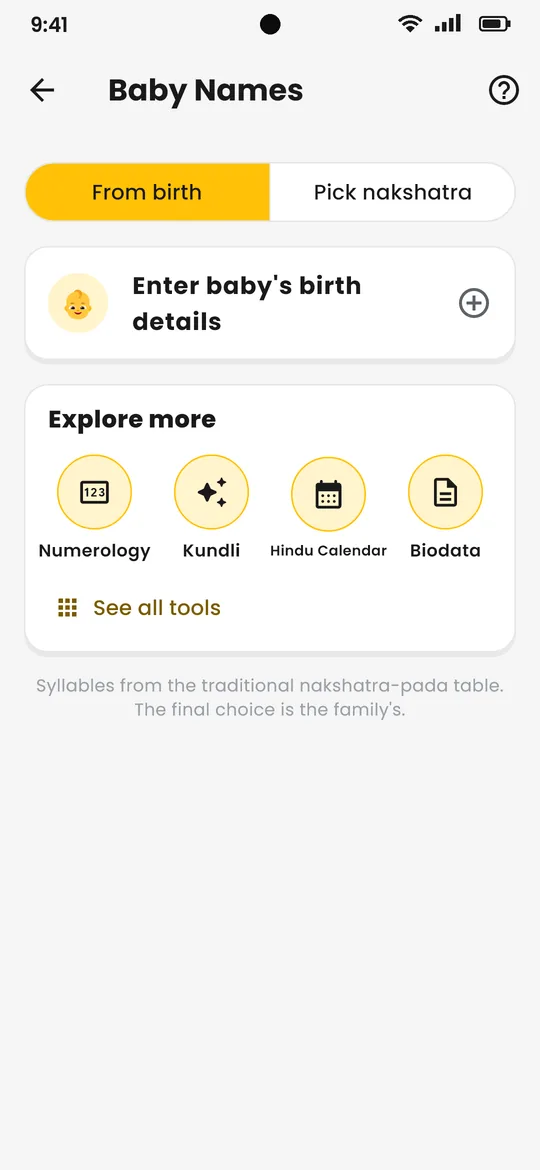
- Add the baby's birth detailsOr choose nakshatra and charan.
- Browse namesFilter boy or girl.
- Save favouritesShare the shortlist.
What are baby names by rashi?
Choosing a baby name by rashi means starting the name with a syllable taken from the baby's birth chart. In Hindu tradition this syllable is called the naam akshar (name letter). It comes from the nakshatra (lunar mansion) and its charan (quarter) where the Moon was at the moment of birth.
The Moon is given special weight in Jyotish because it stands for the mind. So the baby's rashi (moon sign) and the name letter both come from the Moon's position, not the Sun's. This is why a family pandit asks for the exact time of birth before suggesting letters.
Why families follow it
- It ties the name to the child's own chart, so the name "belongs" to the child in a traditional sense.
- The same syllable is later used to find the nakshatra and rashi from a name when birth details are missing, for example in name-based Kundli Milan.
- It narrows thousands of possible names down to a short, meaningful list, which makes family discussion easier.
How the naam akshar is found
The naam akshar is found in three steps: locate the Moon, find its nakshatra, then find the charan inside that nakshatra. Each step follows standard Vedic (Parashari) rules using the sidereal zodiac with Lahiri ayanamsa.
Step 1: the Moon's position
The Moon's sidereal longitude is calculated for the baby's date, time and place of birth. The place matters because the local time zone and coordinates affect the exact moment used.
Step 2: the nakshatra
The 360 degrees of the zodiac are divided into 27 equal nakshatras of 13 degrees 20 minutes each. Ashwini covers 0 to 13°20' of Mesh, Bharani the next 13°20', and so on to Revati at the end of Meen.
Step 3: the charan
Each nakshatra is split into 4 charans (also called padas) of 3 degrees 20 minutes. That makes 108 charans in all, and each one has its own traditional syllable. The Moon moves through roughly one nakshatra a day, so one charan lasts about six hours. Two babies born on the same day can easily get different letters, which is why the birth time must be accurate.
How charans fix the rashi
Each rashi (30 degrees) holds exactly 9 charans. So the first 9 charans (Ashwini 1 to Krittika 1) fall in Mesh, the next 9 (Krittika 2 to Mrigashira 2) in Vrishabh, and so on. That is why some nakshatras are split across two rashis.
Full nakshatra charan akshar table (27 x 4)
This is the standard Vedic naam akshar table used by most North Indian panchangs and by the AstroMilan app. Find the baby's nakshatra, then the charan number, and read the syllable.
| # | Nakshatra | Charan 1 | Charan 2 | Charan 3 | Charan 4 | Rashi |
|---|---|---|---|---|---|---|
| 1 | Ashwini | Chu | Che | Cho | La | Mesh |
| 2 | Bharani | Li | Lu | Le | Lo | Mesh |
| 3 | Krittika | A | I | U | E | Mesh (1), Vrishabh (2 to 4) |
| 4 | Rohini | O | Va | Vi | Vu | Vrishabh |
| 5 | Mrigashira | Ve | Vo | Ka | Ki | Vrishabh (1, 2), Mithun (3, 4) |
| 6 | Ardra | Ku | Gha | Na (ङ) | Chha | Mithun |
| 7 | Punarvasu | Ke | Ko | Ha | Hi | Mithun (1 to 3), Kark (4) |
| 8 | Pushya | Hu | He | Ho | Da (ड) | Kark |
| 9 | Ashlesha | Di | Du | De | Do | Kark |
| 10 | Magha | Ma | Mi | Mu | Me | Simha |
| 11 | Purva Phalguni | Mo | Ta (ट) | Ti | Tu | Simha |
| 12 | Uttara Phalguni | Te | To | Pa | Pi | Simha (1), Kanya (2 to 4) |
| 13 | Hasta | Pu | Sha (ष) | Na (ण) | Tha (ठ) | Kanya |
| 14 | Chitra | Pe | Po | Ra | Ri | Kanya (1, 2), Tula (3, 4) |
| 15 | Swati | Ru | Re | Ro | Ta (त) | Tula |
| 16 | Vishakha | Ti | Tu | Te | To | Tula (1 to 3), Vrishchik (4) |
| 17 | Anuradha | Na | Ni | Nu | Ne | Vrishchik |
| 18 | Jyeshtha | No | Ya | Yi | Yu | Vrishchik |
| 19 | Mula | Ye | Yo | Bha | Bhi | Dhanu |
| 20 | Purva Ashadha | Bhu | Dha (ध) | Pha | Dha (ढ) | Dhanu |
| 21 | Uttara Ashadha | Bhe | Bho | Ja | Ji | Dhanu (1), Makar (2 to 4) |
| 22 | Shravana | Ju | Je | Jo | Gha | Makar |
| 23 | Dhanishta | Ga | Gi | Gu | Ge | Makar (1, 2), Kumbh (3, 4) |
| 24 | Shatabhisha | Go | Sa | Si | Su | Kumbh |
| 25 | Purva Bhadrapada | Se | So | Da (द) | Di | Kumbh (1 to 3), Meen (4) |
| 26 | Uttara Bhadrapada | Du | Tha (थ) | Jha | Na (ञ) | Meen |
| 27 | Revati | De | Do | Cha | Chi | Meen |
Reading the sounds correctly
Roman spelling hides some differences that matter in Hindi. "Ta" in Purva Phalguni is the hard, retroflex ट, while "Ta" in Swati is the soft, dental त (as in Tara). "Da" in Pushya is ड, while "Da" in Purva Bhadrapada is द (as in Dev). Ardra, Hasta and Uttara Bhadrapada each have a different nasal "Na" (ङ, ण, ञ). Since almost no names start with these nasals, families in practice use a name starting with N, or use another syllable of the same rashi.
Rashi-wise starting letters for baby names
When the nakshatra is not known, or the family prefers more choice, names are picked from all the syllables of the baby's rashi. Each rashi gathers the syllables of its 9 charans.
| Rashi (moon sign) | Western sign | Starting syllables |
|---|---|---|
| Mesh | Aries | Chu, Che, Cho, La, Li, Lu, Le, Lo, A |
| Vrishabh | Taurus | I, U, E, O, Va, Vi, Vu, Ve, Vo |
| Mithun | Gemini | Ka, Ki, Ku, Gha, Na, Chha, Ke, Ko, Ha |
| Kark | Cancer | Hi, Hu, He, Ho, Da, Di, Du, De, Do |
| Simha | Leo | Ma, Mi, Mu, Me, Mo, Ta, Ti, Tu, Te |
| Kanya | Virgo | To, Pa, Pi, Pu, Sha, Na, Tha, Pe, Po |
| Tula | Libra | Ra, Ri, Ru, Re, Ro, Ta, Ti, Tu, Te |
| Vrishchik | Scorpio | To, Na, Ni, Nu, Ne, No, Ya, Yi, Yu |
| Dhanu | Sagittarius | Ye, Yo, Bha, Bhi, Bhu, Dha, Pha, Dha (ढ), Bhe |
| Makar | Capricorn | Bho, Ja, Ji, Ju, Je, Jo, Gha, Ga, Gi |
| Kumbh | Aquarius | Gu, Ge, Go, Sa, Si, Su, Se, So, Da |
| Meen | Pisces | Di, Du, Tha, Jha, Na, De, Do, Cha, Chi |
Rashi letters are not the Western sun sign
The rashi here is the Moon's sidereal sign, not the Sun sign printed in magazines. A baby born on 10 April has the Sun in Mesh, but the Moon can be in any of the 12 rashis that day. Always work from the moon sign shown in the Janam Kundli.
Simha and Tula share T sounds
Both lists show Ta, Ti, Tu and Te, but they are different letters. Simha's come from ट (Purva Phalguni and Uttara Phalguni), and Tula's come from त (Swati and Vishakha). A pandit will point a Simha baby towards names like Tanish or Tejas only if the family accepts that the written English T covers both sounds, which many do.
Sample Hindu baby names with meanings, by akshar
The AstroMilan app carries 270 boy and girl names with meanings, grouped by their starting sound. Below is a selection for the most common akshars. Names whose first sound matches the syllable are shown, with exact syllable matches first in the app.
| Akshar (nakshatra) | Boy names | Girl names |
|---|---|---|
| A, I, U, E (Krittika) | Aarav (peaceful), Aditya (the Sun), Ishaan (Lord Shiva), Utkarsh (progress), Uday (rising) | Aadhya (the first power), Ananya (unique), Isha (goddess), Urvi (earth), Esha (desire) |
| Va, Vi (Rohini) | Vihaan (dawn), Vivaan (full of life), Vedant (ultimate knowledge), Vikram (valour) | Vanya (gracious gift), Vidhi (destiny), Vrinda (holy basil), Vaishnavi (Goddess Durga) |
| Ka, Ki (Mrigashira) | Kabir (great), Kartik (son of Shiva), Keshav (Lord Krishna), Kunal (lotus) | Kavya (poetry), Kiara (bright), Kriti (creation), Kashvi (shining) |
| Chu, Che, Cho (Ashwini) | Chirag (lamp), Chetan (consciousness), Chaitanya (awareness), Chinmay (full of knowledge) | Charvi (beautiful), Chandni (moonlight), Chitra (picture) |
| La, Li, Lu (Ashwini, Bharani) | Laksh (aim), Lakshay (goal), Lokesh (lord of the world), Lalit (graceful) | Lavanya (grace), Lakshmi (goddess of wealth), Leela (divine play), Lipi (script) |
| Ha, Hi, Hu (Punarvasu, Pushya) | Harsh (joy), Hardik (heartfelt), Himanshu (the Moon), Hriday (heart) | Harini (deer), Hiral (lustrous), Himani (snow), Hansika (swan) |
| Ma, Mi, Mu, Me (Magha) | Manav (human), Mihir (the Sun), Mukund (Lord Krishna), Mehul (rain), Madhav (Lord Krishna) | Meera (devotee of Krishna), Mahi (earth), Mansi (wise), Megha (cloud) |
| Pa, Pi, Pu (Uttara Phalguni, Hasta) | Parth (Arjun), Pranav (the sacred Om), Piyush (nectar), Pushkar (lotus) | Pari (fairy), Pihu (sweet bird call), Pooja (worship), Prachi (the east) |
| Ra, Ri, Ru (Chitra, Swati) | Rudra (Lord Shiva), Raghav (Lord Ram), Rishabh (excellent), Rohan (ascending) | Radha (Krishna's beloved), Riya (singer), Ruhi (soul), Reva (the Narmada river) |
| Na, Ni, Nu, Ne (Anuradha) | Naitik (moral), Nakul (a Pandava), Nikhil (complete), Nishant (dawn) | Navya (young, new), Nidhi (treasure), Nupur (anklet), Neha (love) |
| Ya, Yu (Jyeshtha) | Yash (fame), Yuvraj (prince), Yug (era), Yatharth (truth) | Yashvi (famous), Yamini (night), Yukti (idea) |
| Bha, Bhi, Bhu (Mula, Purva Ashadha) | Bharat (India), Bhavesh (lord of the world), Bhuvan (the world), Bhaskar (the Sun) | Bhavya (grand), Bhavna (feeling), Bhumi (earth), Bhakti (devotion) |
| Ja, Ji, Ju (Uttara Ashadha, Shravana) | Jay (victory), Jatin (Lord Shiva), Jeevan (life), Jugal (a pair) | Janvi (the Ganga), Jiya (heart), Juhi (jasmine), Jyoti (light) |
| Ga, Gi, Gu (Dhanishta) | Gaurav (pride), Girish (lord of the mountains), Govind (Lord Krishna), Gagan (sky) | Gauri (Goddess Parvati), Gargi (a learned sage), Gunjan (humming), Gayatri (the Vedic mantra) |
| Sa, Si, Su (Shatabhisha) | Sahil (shore), Siddharth (one who has attained the goal), Suraj (the Sun), Sarthak (meaningful) | Saanvi (Goddess Lakshmi), Siya (Sita), Suhani (pleasant), Simran (remembrance of God) |
| Da, Di, Du, De, Do (Ashlesha, Revati) | Daksh (skilful), Dev (god), Dhruv (the Pole Star), Divyansh (part of the divine) | Diya (lamp), Divya (divine), Devika (little goddess), Disha (direction) |
Note that the app matches by the first consonant sound, so a "Da" list may include both द and ध names like Dev and Dhruv. If your family is strict about the exact letter, check the Hindi spelling of each shortlisted name.
How to pick the right name: a step-by-step method
A good name balances tradition, meaning and everyday use. Here is a method many families follow.
- Get accurate birth details. Note the time from the hospital record, not a rounded guess. A few minutes can move the Moon into the next charan near a boundary.
- Find the nakshatra, charan and naam akshar. Use the app, a panchang or the family pandit.
- Make a first list from the exact akshar. If the akshar is Vi, start with names like Vihaan, Vivaan or Vidhi.
- Widen to the rashi letters if needed. If the akshar is rare (such as Gha, Jha or a nasal Na), look at the other syllables of the same rashi.
- Check the meaning. Prefer names with a clear, positive meaning: a deity, a virtue, nature, light, knowledge.
- Say it aloud with the surname. Check how it sounds, how it will be shortened at school, and whether it is easy to spell.
- Optional: check the name number. Some families also look at the Naamank with a numerology calculator and adjust the spelling slightly.
- Shortlist and decide together. Grandparents, parents and the pandit often each suggest one or two names before the ceremony.
Worked example 1: Rohini charan 2
A baby boy is born with the Moon in Rohini, charan 2. The akshar is Va and the rashi is Vrishabh (Taurus). First choices are Varun (god of water), Vansh (lineage) and Vihaan (dawn). If the family wants a wider choice, the Vrishabh list also allows I, U, E and O, so Ishaan, Uday or Ojas are possible.
Worked example 2: Magha charan 3
A baby girl is born with the Moon in Magha, charan 3. The akshar is Mu and the rashi is Simha (Leo). Muskan (smile) begins with the exact syllable. Close choices from the same sound family are Meera, Mahi, Mansi and Megha.
Worked example 3: Revati charan 3
The Moon is in Revati, charan 3, so the akshar is Cha and the rashi is Meen (Pisces). For a girl, Charvi (beautiful) and Chandni (moonlight) start with the exact syllable. For a boy, Chaitanya (awareness) and Charan (feet of the Lord) fit, and Chirag or Chinmay share the Ch sound.
Worked example 4: Ardra charan 3
The akshar is the nasal ङ, which almost no names use. The rashi is Mithun (Gemini), so the family can choose from Ka, Ki, Ku, Ke, Ko or Ha: Kabir, Kavya, Keshav, Kiara or Harsh all work.
Naamkaran sanskar: the naming ceremony basics
Naamkaran is one of the 16 traditional sanskars (life rites) in Hindu dharma. It formally gives the baby a name in the presence of family, with prayers for a long and healthy life.
When it is done
Many families hold it on the 11th or 12th day after birth, once the period of sutak (birth impurity) ends. Others choose the 10th day, the 16th, the 101st day, or a date within the first year. Customs differ by region and community, so the family elders usually decide. Within that window, a good day is picked with a naamkaran muhurat, avoiding days like Amavasya and Rikta tithis (4th, 9th and 14th) in many traditions.
What happens in the ceremony
- A Ganesh puja and a small havan open the ceremony.
- The baby is bathed, dressed in new clothes and placed in the lap of the mother or father.
- In many North Indian homes, the name is written on a bed of rice in a thali with a gold or silver item.
- The father or an elder whispers the chosen name into the baby's right ear.
- Elders bless the baby, and sweets are shared with family and neighbours.
Old rules from the Grihya Sutras
Some Grihya Sutras, the old household ritual texts, suggest that a boy's name have an even number of syllables and a girl's name an odd number ending in a long vowel. Few families follow this strictly today, but it explains why names like Aarav and Ananya feel traditional. Some families also give a private nakshatra name used only in rituals, and a separate public name for daily life.
Common mistakes and myths about rashi names
Most problems come from wrong input data or reading the rules too rigidly.
Mistakes to avoid
- Using the Sun sign. The akshar comes from the Moon's nakshatra, not the Western sun sign of the birth month.
- Ignoring the birth time. A charan lasts about six hours, so the date alone is not enough.
- Getting the place wrong. Using a far-away city changes the local time used and can shift the Moon near a boundary.
- Confusing similar sounds. ट and त, ड and द, or the three nasal Na sounds all look the same in English spelling.
- Choosing only for the letter. A name with an unclear or awkward meaning is a poor trade even if the letter is right.
Myths to set aside
- "The wrong letter brings bad luck." Tradition prefers the naam akshar, but many respected families choose freely. A name given with love and blessings is a good name.
- "Gand mool babies need a special name." Babies with the Moon in Ashwini, Ashlesha, Magha, Jyeshtha, Mula or Revati may have a Gand Mool shanti puja in some families. This is a ritual matter; it does not change the akshar table.
- "You can never change the name later." Many people use the nakshatra name in rituals and a different name in school records.
All of this is traditional guidance for a family custom; the final choice of name is always the family's own decision.
Regional and traditional differences
The 108-syllable table above is the one printed in most Hindi panchangs, but India has more than one practice. It is worth knowing the variations before a debate with relatives.
Shravana and a few other charans
Some panchangs give Shravana as Khi, Khu, Khe, Kho instead of Ju, Je, Jo, Gha. When a family pandit's book differs, it is usual to follow the family's own panchang.
Gujarati rashi letters
Many Gujarati families use a simplified list of letters per rashi instead of syllables: Mesh A, L, E; Vrishabh B, V, U; Mithun K, Chh, Gh; Kark D, H; Simha M, T; Kanya P, Th, N; Tula R, T; Vrishchik N, Y; Dhanu Bh, F, Dh; Makar Kh, J; Kumbh G, S, Sh; Meen D, Ch, Z, Th. This is easier to remember but less precise than the charan table.
South Indian practice
In Tamil Nadu, Kerala, Karnataka and Andhra families, the nakshatra is often more central than the rashi. Many children are named after a family deity or a grandparent, and the birth star is recorded separately for rituals and horoscope matching. The akshar custom is followed by some families, not all.
Name-based nakshatra
The table also works in reverse. When birth time is unknown, astrologers sometimes take the first syllable of the person's name to find a nakshatra and rashi, for example for quick matching or daily rashifal. A birth-time chart is always more accurate where available.
How to find baby names in the AstroMilan app
The baby names tool in AstroMilan finds the naam akshar for you and lists matching names.
- Add the baby's birth details: date, time and place of birth. The app has 5.5 lakh+ Indian towns and villages built in, so you pick the place from a list without GPS.
- Or pick the nakshatra and charan if your pandit has already told you.
- See the result: the naam akshar, the nakshatra and charan, the rashi, and all the syllables of that rashi.
- Browse names with meanings, and filter boy or girl.
- Save favourites and share the shortlist with family.
The calculation uses Lahiri ayanamsa and runs offline. The app is free, has no login, and works in Hinglish, Hindi and English. For the naming day itself, the app's muhurat finder includes Naamkaran among its 11 muhurat kinds, and the aaj ka Panchang shows the day's tithi and nakshatra.
Privacy: the baby's details stay on your phone
The baby's birth details stay on your phone. The nakshatra, charan and naam akshar are calculated on your phone, and there is no login or account. The app sends anonymous usage counts and crash reports to Google Firebase, which never include names or birth details. See the private astrology app page for details.
Questions people ask
How do I find my baby's naam akshar?
Enter the baby's date, time and place of birth. The Moon's sidereal position gives the nakshatra and its charan, and the charan's syllable from the traditional table is the naam akshar. For example, Rohini charan 2 gives Va and Magha charan 1 gives Ma. In AstroMilan you can also pick the nakshatra and charan directly if your pandit already told you.
What are the starting letters for each rashi?
Mesh: Chu, Che, Cho, La, Li, Lu, Le, Lo, A. Vrishabh: I, U, E, O, Va to Vo. Mithun: Ka, Ki, Ku, Gha, Chha, Ke, Ko, Ha. Kark: Hi, Hu, He, Ho, Da to Do. Simha: Ma to Mo, Ta to Te. Kanya: To, Pa, Pi, Pu, Sha, Tha, Pe, Po. The remaining six rashis are listed in the table above.
Is it necessary to name a baby by rashi?
No, it is a tradition, not a rule. Many families follow the naam akshar because it links the name to the child's chart, and the syllable helps later in name-based matching. Many others choose a name for its meaning or after a grandparent. A name given with love and family blessings is perfectly fine either way.
What if no good name starts with my baby's akshar?
Use the other syllables of the same rashi. Each rashi has 9 charans, so you get several more letters to choose from. For Ardra charan 3 (a nasal Na), a Mithun baby can take names starting with Ka, Ki, Ku, Ke, Ko or Ha. Some families also keep the nakshatra name for rituals and use a different name daily.
When should the naamkaran ceremony be done?
Most families do it on the 11th or 12th day after birth, after the sutak period ends. Others choose the 10th, 16th or 101st day, or a date in the first year. Within that window, a good day is chosen from the panchang. AstroMilan's shubh muhurat finder includes a Naamkaran muhurat.
Is the rashi for baby names the same as the sun sign?
No. The rashi used for names is the Moon's sidereal sign at birth, called the moon sign or Chandra rashi. The Sun sign in magazines is based on the Sun and the tropical zodiac. A baby born in mid-April has the Sun in Mesh, but the Moon could be in any rashi. The Janam Kundli shows the correct moon sign.
Why does birth time matter for the name letter?
The Moon moves about one nakshatra a day, so each charan lasts roughly six hours. A baby born at 5 am and one born at 2 pm on the same day may have different charans, and so different akshars. If the birth was close to a charan boundary, even a few minutes matter, so use the hospital time.
Which nakshatra gives which letters for a boy or girl?
The akshar table is the same for boys and girls. Only the names differ. For example, Ashwini gives Chu, Che, Cho and La, which can lead to Chetan or Laksh for a boy and Charvi or Lavanya for a girl. AstroMilan lets you filter the matching names by boy or girl.
How many baby names are in the AstroMilan app?
The app includes 270 Hindu boy and girl names with meanings, grouped by starting sound so they match the naam akshar. You can save favourites and share the shortlist. The app is free with Google ads, needs no login, and the baby's birth details stay on your phone.
Can we also check numerology for the baby's name?
Yes, many families do both. First pick names that start with the naam akshar, then check each name's Naamank with the numerology calculator. If two names on the shortlist are equally liked, some parents choose the one whose name number is friendly with the baby's Mulank. This is optional and only a traditional preference.
Everything in one free app
Kundli Milan, Panchang, Rashifal, Hindu Calendar, Aarti and 20 more tools. No login, and your details never leave your phone.
