
Ank Jyotish
Numerology Calculator for Mulank, Bhagyank and Name Number
अंक ज्योतिष
A numerology calculator turns your date of birth and name into single digits from 1 to 9. Your Mulank is the birth day reduced to one digit, your Bhagyank is the whole date of birth reduced, and your Naamank is the Chaldean total of your name. Each number is ruled by a planet.
Private by design. Your name and birth date are used only on your phone.
On this page
- What is numerology (Ank Jyotish)?
- How to calculate Mulank, Bhagyank and Naamank
- Numbers 1 to 9: ruling planet and traits
- Lucky colours, days, dates and gems for each number
- Bhagyank and Naamank meanings
- Personal year, month and day numbers
- Number compatibility between two people
- Worked examples: three full readings
- Common mistakes and myths
- Regional and traditional differences
- How to use the numerology calculator in AstroMilan
- Privacy: your numbers stay on your phone
- Questions people ask
What you get
- Mulank, Bhagyank and Naamank with meanings
- Personal day, personal month and personal year
- Lucky colours, days and dates
- Number match with a friend or partner
How to use it
- Enter name and date of birthOr pick a saved profile.
- Read your numbersToday, this month and this year.
- CompareSee how your numbers match with someone else.
What is numerology (Ank Jyotish)?
Numerology, called Ank Jyotish (the astrology of numbers) in India, reads a person through a few single digits taken from the date of birth and the name. Each digit from 1 to 9 is linked to one of the nine grahas (planets), so a number carries the nature of its planet. Number 1 belongs to Surya (the Sun), number 8 to Shani (Saturn), and so on.
Indian numerology sits beside Vedic astrology, not in place of it. A Janam Kundli needs the exact birth time and place, while numerology needs only the date and the name. That is why many families use it as a quick first look, for choosing a name spelling, a lucky date or a colour for an important day.
The three core numbers
- Mulank (root or psychic number): from the day of the month you were born. It shows your basic temperament and how you come across.
- Bhagyank (destiny or life path number): from the full date of birth. It shows the direction your life tends to take and the lessons it brings.
- Naamank (name number): from the letters of the name you use. It shows the impression your name creates in the world.
On top of these, numerologists use cycles: the personal year, personal month and personal day. These change with time and tell you what kind of energy the current period carries for you.
How to calculate Mulank, Bhagyank and Naamank
Every calculation in Indian numerology uses one move: add the digits until one digit is left. This is called reducing a number. So 28 becomes 2 + 8 = 10, and 10 becomes 1 + 0 = 1. The final answer is always between 1 and 9.
Mulank from the birth day
Take only the day of the month. Born on the 7th, your Mulank is 7. Born on the 23rd, it is 2 + 3 = 5. Born on the 29th, it is 2 + 9 = 11, then 1 + 1 = 2. The month and year are ignored. So everyone born on the 1st, 10th, 19th or 28th of any month shares Mulank 1.
Bhagyank from the full date
Add every digit of the day, the month and the year, then keep reducing. For 15 August 1994: 1 + 5 + 0 + 8 + 1 + 9 + 9 + 4 = 37, then 3 + 7 = 10, then 1 + 0 = 1. The Bhagyank is 1. You can also add 15 + 8 + 1994 = 2017 and reduce that to 1. Both routes always land on the same single digit, so do not worry if a book uses the other method.
Naamank from the name (Chaldean method)
Write the name in English letters, give each letter its Chaldean value, add them up, and reduce. The unreduced total is called the compound number and some numerologists read it too. AstroMilan shows both, for example "Naamank 6 (total 33)".
| Value | Letters (Chaldean) |
|---|---|
| 1 | A, I, J, Q, Y |
| 2 | B, K, R |
| 3 | C, G, L, S |
| 4 | D, M, T |
| 5 | E, H, N, X |
| 6 | U, V, W |
| 7 | O, Z |
| 8 | F, P |
No letter gets 9 in the Chaldean system. Nine is treated as sacred and complete, so it can appear only as a total, never as a letter value. Spaces, dots and numbers inside a name are ignored.
Numbers 1 to 9: ruling planet and traits
Each number takes its nature from its ruling planet. The table below gives the planet, the core idea of the number, and the main strengths and challenges as AstroMilan describes them. Read it for your Mulank first, then for your Bhagyank.
| Number | Planet | Core nature | Strengths | Watch out for |
|---|---|---|---|---|
| 1 | Surya (Sun) | The born leader | Confidence, courage, starting new ventures, clear decisions | Ego, stubbornness, quick temper |
| 2 | Chandra (Moon) | The gentle peacemaker | Deep empathy, imagination, teamwork, diplomacy | Mood swings, indecision, taking small things to heart |
| 3 | Guru (Jupiter) | The wise guide | Knowledge, discipline, good advice, optimism | Over-advising, rigid views, high expectations of others |
| 4 | Rahu | The unconventional innovator | Original thinking, hard work, practical planning, grasp of technology | Restlessness with sudden change, arguing, feeling misunderstood |
| 5 | Budh (Mercury) | The quick-witted communicator | Communication, sharp intellect, business sense, adaptability | Haste, unfinished tasks, nervous tension |
| 6 | Shukra (Venus) | The loving harmoniser | Love and care, artistic sense, responsibility, charm | Overspending on comfort, seeking approval, difficulty saying no |
| 7 | Ketu | The deep seeker | Research, intuition, spiritual insight, independent thinking | Keeping distance, overthinking, hiding feelings |
| 8 | Shani (Saturn) | The patient achiever | Patience, discipline, sense of justice, long-term vision | Delayed results, over-seriousness, holding emotions back |
| 9 | Mangal (Mars) | The brave warrior | Courage, generosity, leadership, never giving up | Hot temper, impulsive decisions, conflict |
Why Rahu and Ketu get 4 and 7
Indian numerology fits all nine grahas onto the nine digits. The seven visible planets take 1, 2, 3, 5, 6, 8 and 9, and the two shadow points, Rahu and Ketu, take 4 and 7. This is why 4 is linked with sudden turns and unusual ideas, and 7 with inward, spiritual thinking. Some Western books give 4 to Uranus and 7 to Neptune, which follows the same logic with different planets.
Suitable work by number
The app gives each Mulank a list of fields that suit its nature. A few examples: number 1 suits administration, government service and startups; number 3 suits teaching, law and finance; number 5 suits sales, marketing, media and trading; number 7 suits research, data and writing; number 8 suits law, construction, manufacturing and administration; number 9 suits the army, police, sports and surgery. Treat these as leanings, not limits.
Lucky colours, days, dates and gems for each number
Every number has colours, weekdays and dates that are considered favourable for it. Use your Mulank for daily choices. Many people also check the Bhagyank list and favour whatever is common to both.
| Number | Lucky colours | Lucky days | Lucky dates | Gem (traditional) |
|---|---|---|---|---|
| 1 | Gold, orange, yellow | Sunday, Monday | 1, 10, 19, 28 | Ruby (Manikya) |
| 2 | White, cream, light green | Monday, Friday | 2, 11, 20, 29 | Pearl (Moti) |
| 3 | Yellow, saffron, pink | Thursday | 3, 12, 21, 30 | Yellow Sapphire (Pukhraj) |
| 4 | Blue, grey, khaki | Saturday, Sunday | 4, 13, 22, 31 | Hessonite (Gomed) |
| 5 | Green, light grey, sky blue | Wednesday, Friday | 5, 14, 23 | Emerald (Panna) |
| 6 | White, pink, light blue | Friday, Wednesday | 6, 15, 24 | Diamond (Heera) or Opal |
| 7 | Light green, white, pale yellow | Monday, Sunday | 7, 16, 25 | Cat's Eye (Lehsuniya) |
| 8 | Dark blue, black, purple | Saturday | 8, 17, 26 | Blue Sapphire (Neelam) |
| 9 | Red, maroon, pink | Tuesday, Thursday | 9, 18, 27 | Red Coral (Moonga) |
How to use lucky dates
Lucky dates are simply the dates of the month that reduce to your number. For Mulank 5, the 5th, 14th and 23rd all reduce to 5. Families often prefer these dates for small personal starts like an interview, a purchase or sending an important application. For big events such as a wedding or griha pravesh, a proper shubh muhurat from the Panchang carries more weight in tradition than a number date.
A word on gemstones
Gems are strong remedies in Jyotish. Hessonite, Cat's Eye and Blue Sapphire especially are never worn on a number alone. The app itself adds a note to every gem: consult an experienced astrologer with your full chart first, and for Neelam a trial period is the custom. Simple remedies are safer to start with, like the planet mantra (for example "Om Ghrinih Suryaya Namah" for 1 or "Om Sham Shanaishcharaya Namah" for 8), charity on the planet's day, or respect for elders.
Bhagyank and Naamank meanings
The same digit reads a little differently depending on where it appears. As a Mulank it describes your temperament. As a Bhagyank it describes your life path. As a Naamank it describes the image your name projects.
Bhagyank: your life path
- Bhagyank 1: leadership and making your own mark; the lesson is to trust yourself while staying humble.
- Bhagyank 2: partnership and cooperation; success often comes with the right partner or team.
- Bhagyank 3: knowledge and guidance; teaching, advice and creativity earn you respect.
- Bhagyank 4: hard work and building something solid; sudden turns teach new ways of thinking.
- Bhagyank 5: freedom, travel and change; communication and business open doors.
- Bhagyank 6: love, service and family; caring for yourself while caring for others is the key lesson.
- Bhagyank 7: a search for truth; research and spirituality bring real fulfilment.
- Bhagyank 8: karma, patience and material success; results come late but in abundance.
- Bhagyank 9: service, courage and humanity; turning anger into compassion makes a true leader.
Naamank: the vibration of your name
A Naamank 3 name is considered very favourable for education and public life, and a Naamank 5 name is considered excellent for business and communication. Naamank 1 gives a distinct, leader-like identity. Naamank 8 gives a serious reputation that grows with sustained effort, though early success may be slow. Naamank 4 and 7 suit technology, research and specialist work, and may need extra effort in social circles.
Does your name support your Mulank?
The app also compares your Naamank with your Mulank. If the two are friendly numbers, your name is said to support your nature. If they are neutral, no change is needed. If they clash, some people add or change one letter in the spelling to bring the total into a friendly number. This is optional, and the app suggests asking an expert before changing an official name.
Personal year, month and day numbers
Your personal numbers show which part of a nine-year cycle you are in. Personal year 1 starts a new cycle and personal year 9 closes it. The month and day numbers are smaller waves inside that year.
How the app calculates them
- Personal year: add the digits of your birth day, your birth month and the current year, then reduce. In AstroMilan the personal year turns over on your birthday, so before your birthday the previous calendar year is used.
- Personal month: add the personal year number and the calendar month number (January = 1, October = 10), then reduce.
- Personal day: add the personal month number and today's date, then reduce.
What each personal year brings
| Personal year | Theme | Focus on | Avoid |
|---|---|---|---|
| 1 | Fresh starts | A new job, skill or goal; taking initiative | Clinging to the past |
| 2 | Patience and partnership | Teamwork, family, relationships | Rushing, confrontation |
| 3 | Joy and expression | Writing, speaking, art, new friends | Gossip, needless spending |
| 4 | Building foundations | Health, home, finances, routine | Shortcuts and laziness |
| 5 | Change and travel | Flexibility, learning, new places | Hasty decisions, heavy risk |
| 6 | Family and love | Home, marriage, children, care | Carrying everyone's burden alone |
| 7 | Reflection | Study, research, meditation | Isolation and big risks |
| 8 | Achievement | Career, business growth, clean accounts | Ego, greed, neglecting health |
| 9 | Completion | Finishing old work, charity, forgiveness | Starting a big new venture |
The personal day is the most practical of the three. A personal day 4 is good for making a list and finishing tasks one by one. A personal day 7 asks for quiet time and reading. A personal day 8 is good for important work and money decisions. Pair it with the aaj ka Panchang if you also follow tithi and nakshatra for the day.
Number compatibility between two people
Numerology compatibility compares the Mulank of two people. Each number has a list of friendly, neutral and challenging numbers, and the pair is judged by those lists. It is a simple, light check, very different from a full Kundli Milan with 36 gunas.
| Number | Friendly | Neutral | Challenging |
|---|---|---|---|
| 1 | 1, 2, 3, 9 | 4, 5, 7 | 6, 8 |
| 2 | 1, 2, 5 | 3, 6, 7, 9 | 4, 8 |
| 3 | 1, 2, 3, 9 | 4, 7, 8 | 5, 6 |
| 4 | 5, 6, 7, 8 | 3, 4 | 1, 2, 9 |
| 5 | 1, 5, 6 | 3, 4, 7, 8, 9 | 2 |
| 6 | 4, 5, 6, 8 | 3, 7, 9 | 1, 2 |
| 7 | 4, 5, 6, 7 | 1, 3, 9 | 2, 8 |
| 8 | 4, 5, 6, 8 | 3, 7 | 1, 2, 9 |
| 9 | 1, 2, 3, 9 | 6, 7 | 4, 5, 8 |
The rule the app follows
Two people are a friendly match if they share the same Mulank, or if either number lists the other as friendly. If neither is friendly but either lists the other as challenging, the match is challenging. Everything else is neutral. Because the check goes both ways, 1 and 5 count as friendly: 1 lists 5 only as neutral, but 5 lists 1 as a friend.
What the result means
A friendly pair finds communication easy and understands each other's strengths. A neutral pair clicks on some things and needs compromise on others. A challenging pair is far from impossible; it simply needs more patience and talking. For marriage, the app itself suggests a full Kundli Milan rather than relying on numbers. For fun between friends, the love calculator is lighter still.
Worked examples: three full readings
Here is how the numbers come together for real dates. You can check each step by hand and then compare with the app.
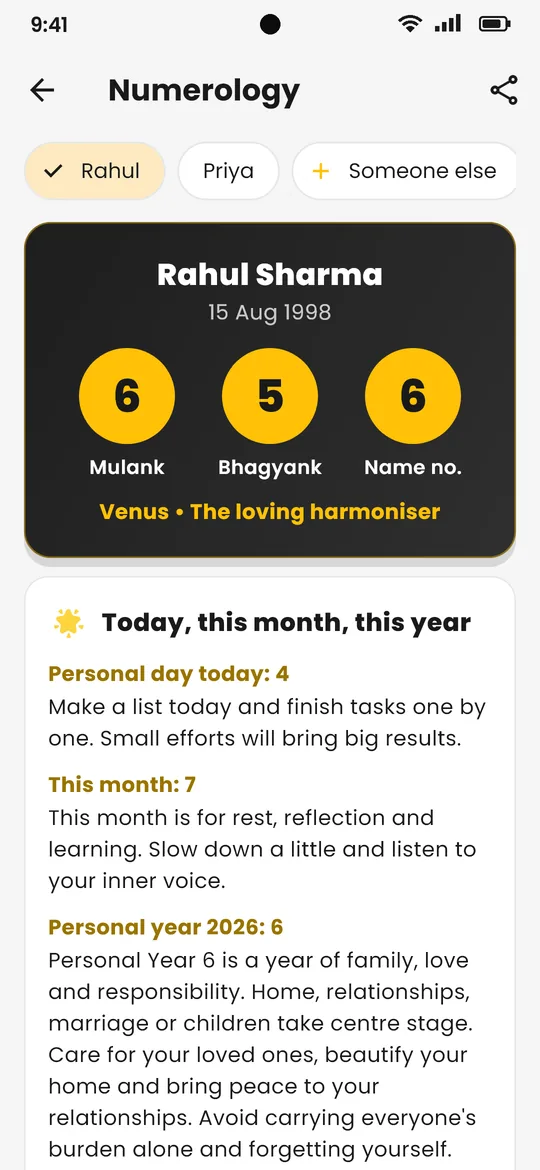
Example 1: Rahul Sharma, born 15 August 1994
- Mulank: 1 + 5 = 6. Ruled by Venus: caring, artistic, responsible.
- Bhagyank: 1 + 5 + 0 + 8 + 1 + 9 + 9 + 4 = 37, 3 + 7 = 10, 1 + 0 = 1. Life path of leadership.
- Naamank: RAHUL = 2 + 1 + 5 + 6 + 3 = 17. SHARMA = 3 + 5 + 1 + 2 + 4 + 1 = 16. Total 33, 3 + 3 = 6. Naamank 6.
- Name and Mulank: both are 6, so the name supports his nature.
- Lucky colours and dates (Mulank 6): white, pink, light blue; Friday and Wednesday; the 6th, 15th and 24th.
His personal year on 6 October 2026: his birthday on 15 August has passed, so use 2026. Day 15 gives 6, month 8 gives 8, year 2026 gives 10. 6 + 8 + 10 = 24, 2 + 4 = 6. Personal year 6, a year of family and responsibility. Personal month for October: 6 + 10 = 16, so 7. Personal day for the 6th: 7 + 6 = 13, so 4, a day for finishing tasks one by one.
Example 2: Priya, born 29 January 1997
- Mulank: 2 + 9 = 11, 1 + 1 = 2. Ruled by the Moon.
- Bhagyank: 2 + 9 + 0 + 1 + 1 + 9 + 9 + 7 = 38, 3 + 8 = 11, 1 + 1 = 2.
- Naamank: PRIYA = 8 + 2 + 1 + 1 + 1 = 13, 1 + 3 = 4. Naamank 4.
- Name and Mulank: 2 lists 4 as challenging, so the app marks the name as not matching the Mulank. Some people would try a spelling that totals 1, 2 or 5. Many keep the name as it is, which is equally valid.
Example 3: checking a pair
Rahul has Mulank 6 and Priya has Mulank 2. Number 6 lists 2 as challenging, and neither lists the other as friendly, so the pair reads as challenging: a relationship that needs more patience and clear talk. If Priya were born on the 14th instead (Mulank 5), the pair would be friendly, because 6 lists 5 as a friend.
Lo Shu grid for Example 1
The app also draws a Lo Shu grid, a 3 by 3 square arranged as 4 9 2 / 3 5 7 / 8 1 6. It counts the digits of the date plus the Mulank and Bhagyank. For 15 August 1994 the digits are 1, 5, 8, 1, 9, 9, 4, plus Mulank 6 and Bhagyank 1. So 1 appears three times, 9 twice, and 4, 5, 6 and 8 once each. The missing numbers are 2, 3 and 7. The app then lists the simple remedy of each missing number's planet, such as the Moon for 2 and Jupiter for 3.
Common mistakes and myths
Most wrong numbers come from small slips in the method. Most worry comes from reading a single number as fate.
Calculation mistakes
- Using the month in the Mulank. Mulank uses the birth day only. Born on 3 December, your Mulank is 3, not 3 + 1 + 2.
- Stopping at two digits. 11, 22 or 29 must be reduced further. AstroMilan always reduces to a single digit from 1 to 9.
- Using the wrong name. Use the spelling you sign and are called by, not a nickname you never use or a spelling from an old form.
- Mixing letter systems. Chaldean and Pythagorean letter values differ, so a name total from one system will not match a book using the other.
- Changing the personal year on 1 January. Some books do this. The app changes it on your birthday. Know which rule a reading follows before comparing.
Myths to set aside
- "Number 4 and 8 are unlucky." They are linked with Rahu and Saturn, which ask for patience and hard work. Their strengths, like discipline and original thinking, are real.
- "A challenging pair cannot marry." Number compatibility is a light indicator only. It is not a substitute for Kundli Milan or for knowing the person.
- "Change your name and life will change." A spelling change is a small traditional step at most. Effort, health and good choices matter far more.
Numerology readings are for cultural guidance and self-reflection; decisions about health, money or marriage need your own judgement and, where needed, professional advice.
Regional and traditional differences
Indian numerology is not one fixed school. Methods vary between books, families and regions, and it helps to know where differences come from.
Chaldean versus Pythagorean
The Chaldean system, used by AstroMilan and popularised in India by Cheiro's books, gives letters values from 1 to 8 based on sound. The Pythagorean system simply numbers the alphabet in order from 1 to 9 (A = 1 up to I = 9, then J = 1 again). Most Indian name-correction practice follows Chaldean values, which is why a Naamank from a Western website may look different.
Master numbers
Some Western numerologists keep 11, 22 and 33 unreduced as "master numbers". Traditional Indian Ank Jyotish reduces everything to 1 to 9 so that each number maps to one graha. The app follows the Indian approach.
Names in Indian scripts
Chaldean values work on English letters. A name written only in Devanagari has no Naamank in the app, so type it in English the way you spell it on documents. Some pandits use separate systems for Hindi akshars; those are different from the Chaldean method and not mixed in here.
Numerology and the naming ceremony
In many families the first letter of a baby's name still comes from the Moon's nakshatra, the naam akshar, and numerology is used only to fine-tune the spelling. If you are naming a child, start with baby names by rashi and then check the Naamank of the shortlist.
How to use the numerology calculator in AstroMilan
The calculator is in the AstroMilan app under the numerology tool. It takes under a minute.
- Enter your name and date of birth, or pick a saved profile you already made for your kundli.
- Read your numbers: Mulank, Bhagyank and Naamank with meanings, strengths, career fields, lucky colours, days and dates, the planet mantra and simple remedies.
- See today, this month and this year: your personal day, month and year with what to focus on.
- Check the Lo Shu grid and the missing numbers in your date of birth.
- Compare with someone: choose a friend or partner to see if your Mulanks are friendly, neutral or challenging.
A view of the next 12 months, with each month's personal number, opens after a short ad. You can share your reading as text with family. The app is free, needs no login and works in Hinglish, Hindi and English. For daily guidance by moon sign, see the rashifal as well.
Privacy: your numbers stay on your phone
Your name and birth date are used only on your phone. Every number on this page is calculated on your phone, and there is no login or account to create. The app sends anonymous usage counts and crash reports to Google Firebase, but these never include your name or birth details. Read more about how this works on the private astrology app page.
Questions people ask
What is my Mulank if I was born on the 29th?
Add the two digits of the day: 2 + 9 = 11. Since 11 has two digits, add again: 1 + 1 = 2. Your Mulank is 2, ruled by the Moon. Everyone born on the 2nd, 11th, 20th or 29th of any month shares Mulank 2, with lucky colours white, cream and light green and lucky days Monday and Friday.
What is the difference between Mulank and Bhagyank?
Mulank comes only from the day of birth and shows your basic temperament, how you think and react day to day. Bhagyank comes from the full date, day plus month plus year, and shows your life path and the lessons life brings. Two people born on the 15th share Mulank 6, but their Bhagyank differs if the month or year is different.
How do I calculate my Bhagyank?
Add every digit of your date of birth and keep reducing until one digit is left. For 15 August 1994: 1 + 5 + 0 + 8 + 1 + 9 + 9 + 4 = 37, then 3 + 7 = 10, then 1 + 0 = 1. The Bhagyank is 1. Adding 15 + 8 + 1994 and reducing gives the same single digit.
How is Naamank calculated from my name?
Write your name in English letters and give each letter its Chaldean value: A, I, J, Q, Y = 1; B, K, R = 2; C, G, L, S = 3; D, M, T = 4; E, H, N, X = 5; U, V, W = 6; O, Z = 7; F, P = 8. Add them and reduce to one digit. Use the spelling you actually use every day.
Which Mulank is the luckiest?
No Mulank is luckier than another in Indian numerology. Each number has its own planet, strengths and lessons. Number 1 brings leadership, 3 brings wisdom, 8 brings slow but lasting success, and so on. What traditional numerology looks at is harmony: whether your Naamank and Bhagyank are friendly with your Mulank, and how you use your number's strengths.
Should I change my name spelling for numerology?
It is optional. If your Naamank clashes with your Mulank, some people add or change one letter to bring the total into a friendly number. Many successful people never do this. Changing an official name involves documents and practical effort, so take advice from an experienced person first and treat it as a small traditional step, not a cure.
What is a personal year number?
It is the number of the year you are living through in a nine-year cycle. Add your birth day, birth month and the current year, then reduce. In AstroMilan it changes on your birthday. Personal year 1 is for new starts, 4 for building foundations, 8 for career and money, and 9 for finishing old matters.
Can numerology tell marriage compatibility?
It gives a light indication only. The app compares two Mulanks and calls the pair friendly, neutral or challenging using each number's lists. For marriage, families traditionally rely on Kundli Milan with ashtakoot gunas, Manglik check and the full chart. Use numerology as one small input, and use your own judgement for the decision.
Is numerology part of Vedic astrology?
Ank Jyotish is closely linked to Jyotish because each number is ruled by one of the nine grahas, but it is a separate method. Classical Parashari astrology works from the birth chart, which needs time and place of birth. Numerology needs only the date and name. Many families use both: the Janam Kundli for depth, numbers for quick daily choices.
Is the AstroMilan numerology calculator free?
Yes. Mulank, Bhagyank, Naamank, the personal numbers, lucky colours and the Lo Shu grid are free. The app is supported by Google ads, and the 12-month view opens after a short ad. There is no login, and your name and birth date are used only on your phone.
Everything in one free app
Kundli Milan, Panchang, Rashifal, Hindu Calendar, Aarti and 20 more tools. No login, and your details never leave your phone.
