
Birth chart
Janam Kundli: your birth chart explained house by house
जन्म कुंडली
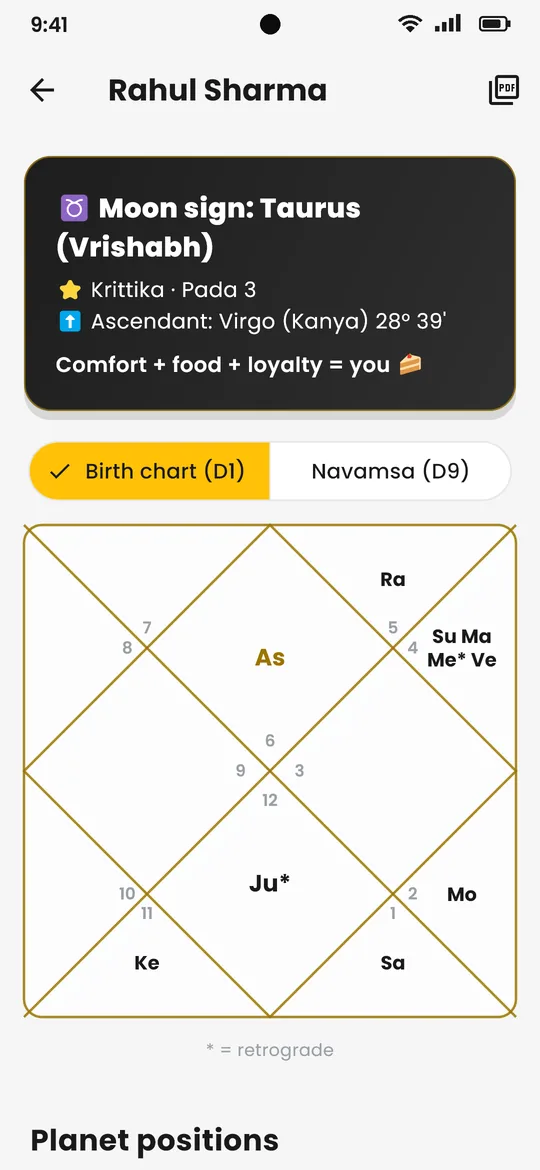
A Janam Kundli is a birth chart that maps where the Sun, Moon, planets, Rahu and Ketu stood in the 12 rashis at the exact time and place of your birth. It shows your Lagna, Moon sign and nakshatra, and is read with the Vimshottari Dasha and classical yogas to understand nature, career, marriage and timing.
Private by design. Your birth time is personal. AstroMilan never sends it anywhere. The kundli is drawn by the app on your phone.
On this page
- What is a Janam Kundli?
- The 12 houses of the kundli
- The 12 rashis and 9 grahas
- How to read a North Indian kundli chart
- Nakshatra, pada and naam akshar
- Vimshottari Dasha: the timing system
- The 23 classical yogas in your kundli
- A sample kundli reading, step by step
- Common mistakes when reading a kundli
- North, South and East Indian chart styles
- How to make your Janam Kundli in AstroMilan
- Your birth details stay private
- Questions people ask
What you get
- Lagna (D1) and Navamsa (D9) charts in North Indian style
- Planet positions with sign, degree, nakshatra, pada and retrograde marks
- Moon sign, Sun sign, Lagna and your naam akshar
- Vimshottari Dasha timeline with the current Mahadasha and Antardasha
- Kundli phal: 23 classical yogas such as Gajakesari and Budhaditya, explained
- A 9 page Janam Kundli PDF to save or send
How to use it
- Enter birth detailsName, date, exact time and place of birth.
- See your chartsSwitch between the Lagna and Navamsa charts. Retrograde planets are marked.
- Read your Dasha and yogasFind out which planet period you are in and which yogas your chart holds.
- Save the PDFMake a 9 page kundli report you can keep or share with the family.
What is a Janam Kundli?
A Janam Kundli (also called janam patri or birth chart) is a picture of the sky as seen from your birthplace at the minute you were born. It records which rashi (zodiac sign) each of the nine grahas occupied and which sign was rising on the eastern horizon.
In Indian families the kundli is made soon after a child is born, often by the family pandit, and is used for naamkaran, for Kundli Milan before marriage, and for choosing muhurats through life.
What goes into a kundli
- Date of birth: fixes the positions of the slow planets and the Sun.
- Time of birth: fixes the Lagna (ascendant) and the exact Moon degree. The Lagna changes roughly every two hours.
- Place of birth: gives latitude, longitude and time zone. The same clock time in Kolkata and Ahmedabad gives a different Lagna.
Sidereal zodiac and Lahiri ayanamsa
Vedic astrology uses the sidereal zodiac, which is tied to the fixed stars. The difference from the western (tropical) zodiac is called the ayanamsa, currently a little over 24 degrees. Most Indian panchangs and the Government of India's Rashtriya Panchang use the Lahiri (Chitrapaksha) ayanamsa, and so does AstroMilan.
The 12 houses of the kundli
The chart is divided into 12 bhavs (houses). The 1st house begins with the Lagna, and each following house is the next sign. Each house rules certain areas of life.
| House | Name | Main areas of life |
|---|---|---|
| 1st | Tanu bhav | Self, body, personality, overall health |
| 2nd | Dhan bhav | Family, savings, speech, food |
| 3rd | Sahaj bhav | Courage, younger siblings, effort, short travel |
| 4th | Sukh bhav | Mother, home, vehicles, inner peace |
| 5th | Putra bhav | Children, intelligence, education, past merit |
| 6th | Ripu bhav | Enemies, debts, illness, competition, service |
| 7th | Kalatra bhav | Marriage, spouse, partnerships |
| 8th | Ayu bhav | Longevity, sudden events, hidden matters, in laws |
| 9th | Dharma bhav | Luck, father, guru, religion, long journeys |
| 10th | Karma bhav | Career, status, work in the world |
| 11th | Labh bhav | Income, gains, friends, elder siblings |
| 12th | Vyay bhav | Expenses, foreign lands, sleep, moksha |
Kendra, trikona and dusthana
Houses 1, 4, 7 and 10 are kendras (angles) and give strength. Houses 1, 5 and 9 are trikonas (trines) and give fortune. Houses 6, 8 and 12 are dusthanas, linked with obstacles. Many yogas are defined by which lord sits in which of these groups.
House lords (bhavesh)
The lord of a house is the planet that rules the sign in it. For a Simha Lagna, the 1st house holds Simha, so the Sun is the Lagna lord; the 7th house holds Kumbh, so Saturn is the 7th lord and speaks for marriage. Where each lord sits, and in what condition, is as important as which planets occupy the house.
The 12 rashis and 9 grahas
Every house holds one rashi, and every rashi has a ruling planet. Knowing the lord of each sign is the first skill in reading any kundli.
| No. | Rashi | English | Lord |
|---|---|---|---|
| 1 | Mesh | Aries | Mars (Mangal) |
| 2 | Vrishabh | Taurus | Venus (Shukra) |
| 3 | Mithun | Gemini | Mercury (Budh) |
| 4 | Kark | Cancer | Moon (Chandra) |
| 5 | Simha | Leo | Sun (Surya) |
| 6 | Kanya | Virgo | Mercury (Budh) |
| 7 | Tula | Libra | Venus (Shukra) |
| 8 | Vrishchik | Scorpio | Mars (Mangal) |
| 9 | Dhanu | Sagittarius | Jupiter (Guru) |
| 10 | Makar | Capricorn | Saturn (Shani) |
| 11 | Kumbh | Aquarius | Saturn (Shani) |
| 12 | Meen | Pisces | Jupiter (Guru) |
The nine grahas
The navagrahas are Surya (Sun), Chandra (Moon), Mangal (Mars), Budh (Mercury), Guru (Jupiter), Shukra (Venus), Shani (Saturn), and the two lunar nodes Rahu and Ketu. Rahu and Ketu are always exactly opposite each other and always move backward through the zodiac.
Natural benefics and malefics
Jupiter and Venus are the natural benefics (shubh grahas). Mercury is benefic when not joined with malefics, and a bright, waxing Moon is also counted as benefic. Saturn, Mars, Rahu, Ketu and the Sun are natural malefics (krur grahas). This does not make them bad: Saturn gives discipline and Mars gives courage. In practice, a planet's results also depend on which houses it rules for your particular Lagna. For Vrishabh and Tula Lagna, for example, Saturn rules a kendra and a trikona and is treated as the most helpful planet in the chart.
Exaltation and debilitation
Each of the seven visible planets has a sign where it is strongest (uchcha) and one where it is weakest (neecha). The Sun is exalted in Mesh, Moon in Vrishabh, Mars in Makar, Mercury in Kanya, Jupiter in Kark, Venus in Meen and Saturn in Tula. Each is debilitated in the opposite sign.
How to read a North Indian kundli chart
The North Indian chart is a square with diamond shaped houses. The houses stay fixed and the sign numbers move, which is the opposite of the South Indian chart.
Step by step
- Find the top centre diamond. That is always the 1st house (Lagna).
- Read the number written in it. That number is your Lagna rashi: 1 is Mesh, 5 is Simha, 10 is Makar, and so on.
- Move anti clockwise for houses 2 to 12. The top left triangle is the 2nd house, the left diamond is the 4th, the bottom diamond is the 7th and the right diamond is the 10th.
- Read the planet abbreviations in each house, such as Su, Mo, Ma, Me, Ju, Ve, Sa, Ra and Ke. A mark next to a planet shows it is retrograde (vakri).
Three things to note first
- Lagna and its lord: where the 1st house lord sits tells a lot about the direction of life.
- Moon sign and nakshatra: your rashi for rashifal, Sade Sati and matching.
- Planets in kendras: strong planets in houses 1, 4, 7 and 10 shape the chart.
Navamsa (D9) chart
The Navamsa divides each sign into nine parts of 3 degrees 20 minutes. It is read for marriage, the spouse and the true strength of planets. A planet weak in the Lagna chart but strong in the Navamsa is said to improve with time. Movable signs start their navamsa count from themselves, fixed signs from the 9th sign, and dual signs from the 5th.
Nakshatra, pada and naam akshar
The zodiac is also split into 27 nakshatras of 13 degrees 20 minutes each, and every nakshatra into four padas (quarters). The Moon's nakshatra at birth, called the janma nakshatra, is one of the most used facts in the kundli.
What the janma nakshatra decides
- The starting Mahadasha in the Vimshottari Dasha.
- Gana, Nadi and Yoni for Kundli Milan.
- Tara Bala when choosing a shubh muhurat.
- The naam akshar, the traditional first sound for the name, from the pada. See baby names by rashi.
For example, the four padas of Ashwini give the sounds Chu, Che, Cho and La. A child born with the Moon in Ashwini pada 3 would traditionally get a name starting with Cho.
Vimshottari Dasha: the timing system
Vimshottari Dasha is the most used timing system in Vedic astrology. It divides a 120 year life cycle into nine Mahadashas (major periods), each ruled by one planet, always in the same order.
| Mahadasha | Years | Starts at birth for Moon in |
|---|---|---|
| Ketu | 7 | Ashwini, Magha, Mula |
| Venus | 20 | Bharani, Purva Phalguni, Purva Ashadha |
| Sun | 6 | Krittika, Uttara Phalguni, Uttara Ashadha |
| Moon | 10 | Rohini, Hasta, Shravana |
| Mars | 7 | Mrigashira, Chitra, Dhanishta |
| Rahu | 18 | Ardra, Swati, Shatabhisha |
| Jupiter | 16 | Punarvasu, Vishakha, Purva Bhadrapada |
| Saturn | 19 | Pushya, Anuradha, Uttara Bhadrapada |
| Mercury | 17 | Ashlesha, Jyeshtha, Revati |
How the balance at birth is found
The first Mahadasha is already partly over at birth. If the Moon has crossed 40 percent of its nakshatra, then 60 percent of that planet's period is left. For example, Moon 40 percent through Rohini leaves 6 of the Moon's 10 years.
Antardasha
Each Mahadasha is divided into nine Antardashas (sub periods) in the same order, starting with the Mahadasha lord itself. The length of each is in proportion to its years. Saturn Antardasha within Venus Mahadasha, for example, lasts 20 times 19 divided by 120, which is a little over 3 years.
How Dasha is used
Pandits read events through the planet whose Dasha is running and the houses it rules and occupies. A Jupiter period for someone whose Jupiter rules the 9th and sits in the 10th is traditionally hopeful for career and learning.
The 23 classical yogas in your kundli
A yoga is a special combination of planets with a known result. AstroMilan checks 23 well known yogas from classical texts such as Brihat Parashara Hora Shastra and Phaladeepika.
| Yoga | Simple rule |
|---|---|
| Gajakesari | Jupiter in a kendra (1, 4, 7, 10) from the Moon |
| Budhaditya | Sun and Mercury in the same sign |
| Chandra Mangal | Moon and Mars in the same sign |
| Ruchaka | Mars in own or exalted sign in a kendra from Lagna |
| Bhadra | Mercury in own or exalted sign in a kendra |
| Hamsa | Jupiter in own or exalted sign in a kendra |
| Malavya | Venus in own or exalted sign in a kendra |
| Shasha | Saturn in own or exalted sign in a kendra |
| Sunapha | A planet (not Sun, Rahu, Ketu) in the 2nd from the Moon |
| Anapha | A planet in the 12th from the Moon |
| Durudhara | Planets in both the 2nd and 12th from the Moon |
| Kemdrum | No planet on either side of the Moon, without cancellation |
| Vesi | A planet (not Moon) in the 2nd from the Sun |
| Vasi | A planet in the 12th from the Sun |
| Ubhayachari | Planets on both sides of the Sun |
| Adhi | Two or more benefics in the 6th, 7th, 8th from the Moon |
| Amala | A benefic in the 10th from Lagna or Moon |
| Saraswati | Mercury, Jupiter and Venus in kendras, trikonas or the 2nd |
| Neecha Bhanga | A debilitated planet whose sign lord is in a kendra |
| Lakshmi | 9th lord in own or exalted sign in a kendra or trikona |
| Vipreet Raj | Lord of the 6th, 8th or 12th in another of these houses |
| Dhan | Lords of the 2nd and 11th linked by conjunction or placement |
| Raj | A kendra lord together with a trikona lord |
The first eight on this list include the five Pancha Mahapurusha yogas (Ruchaka, Bhadra, Hamsa, Malavya, Shasha), which classical texts rate very highly. Yogas that depend on the Lagna are only checked when the birth time is known.
Reading yogas sensibly
Almost every chart has a few yogas. Their results depend on the strength of the planets involved and on when their Dasha runs. A Gajakesari yoga shows its best in the Jupiter or Moon period. Kemdrum, the one difficult yoga on the list, is often cancelled by other placements, and AstroMilan checks the common cancellations before showing it.
A sample kundli reading, step by step
Here is a short example to show how the pieces fit together. The chart below is a made up teaching example, not a real person.
| Graha | Rashi | House from Kanya Lagna |
|---|---|---|
| Moon | Vrishabh (Rohini) | 9th |
| Sun, Mercury | Kumbh | 6th |
| Venus | Meen | 7th |
| Saturn | Makar | 5th |
| Jupiter | Simha | 12th |
| Mars | Mithun | 10th |
Step 1: Lagna and its lord
The Lagna is Kanya, ruled by Mercury. Mercury sits in the 6th house with the Sun, which forms Budhaditya yoga. Traditionally this points to an analytical mind and success in service, competition, law or health related work.
Step 2: Moon and nakshatra
The Moon is exalted in Vrishabh in the 9th house of fortune, in Rohini nakshatra. The rashi is Vrishabh, so this person reads the Vrishabh rashifal. Rohini is ruled by the Moon, so life starts in the Moon Mahadasha, followed by Mars (7 years), Rahu (18 years) and Jupiter (16 years).
Step 3: Yogas
Jupiter in Simha is 4th from the Moon, a kendra, so Gajakesari yoga is present. Venus, the 9th lord for Kanya Lagna, is exalted in Meen in the 7th house, a kendra, which forms both Malavya and Lakshmi yoga. Mars in the 2nd from the Moon gives Sunapha yoga.
Step 4: Points of care
Jupiter, a key benefic, sits in the 12th house, which tradition links with expenses and foreign connections. Mars is in the 2nd from the Moon, so by the rule that counts the 2nd house the chart is mildly Manglik from the Moon, though not from the Lagna. A pandit would weigh all of this together, and would time events by the running Dasha.
Common mistakes when reading a kundli
Most confusion about kundlis comes from a few avoidable mistakes.
Wrong or rounded birth time
A time rounded to the nearest hour can shift the Lagna and every house. If you are unsure, note it and treat house based results as approximate. The Moon sign is usually stable within a few hours.
Confusing Moon sign, Sun sign and Lagna
Your rashi in India means the Moon sign. Your Sun sign in the sidereal zodiac is often one sign behind the western sign. Your Lagna is a third, separate sign. All three are shown in your kundli.
Reading one planet in isolation
Saturn in the 7th house does not by itself decide anything about marriage. Its sign, aspects, the 7th lord, Venus and the Navamsa all matter. Good reading always combines several factors.
Fear of one dosha
Manglik dosha, Sade Sati or Kaal Sarp are common. They are signs to be careful in some areas, not sentences. See what they really mean on the dosh check page. A kundli reading is traditional guidance, and life decisions need your own judgement too.
North, South and East Indian chart styles
The planets are the same in every style; only the drawing differs. Knowing the styles helps when relatives send you an old kundli.
| Style | Shape | What stays fixed | Where used |
|---|---|---|---|
| North Indian | Square with diamonds | Houses; Lagna always top centre | North and Central India |
| South Indian | Square grid of 12 boxes | Signs; Meen top left, then clockwise | Tamil Nadu, Kerala, Karnataka, Andhra Pradesh |
| East Indian | Square with diagonal cuts | Signs; Mesh at top, anti clockwise | Bengal, Odisha, Assam |
Handwritten janam patris in many families also include the panchang details of the birth day, such as tithi, yoga and karana, which you can see for any day in Aaj ka Panchang.
How to make your Janam Kundli in AstroMilan
The app makes the full kundli on your phone in under a minute.
- Enter the name, date, exact time and place of birth. Pick the place from more than 5.5 lakh Indian towns and villages.
- See the Lagna (D1) and Navamsa (D9) charts in North Indian style, with retrograde planets marked.
- Check planet positions with sign, degree, nakshatra and pada, plus your Moon sign, Sun sign, Lagna and naam akshar.
- Open the Vimshottari Dasha timeline to see your current Mahadasha and Antardasha.
- Read the kundli phal for the 23 yogas, and save the 9 page PDF. The yoga reading and the PDF open after a short ad.
The 9 page PDF has a cover, the charts, planet positions, yogas, your nature, two pages of planet readings, career and marriage, and Dasha and doshas. Switch between Hindi, Hinglish and English at any time.
Your birth details stay private
Your birth time and place are personal details. AstroMilan needs no login, your birth details stay on your phone, and the kundli is calculated on your phone. It works offline. Anonymous usage counts and crash reports go to Google Firebase without personal details. See the privacy page for exactly what is sent.
Questions people ask
Is the Janam Kundli in AstroMilan free?
Yes. The Lagna and Navamsa charts, planet positions and Vimshottari Dasha are free. The 23 yoga reading and the 9 page kundli PDF open after a short ad. The app is supported by Google AdMob ads, and there is no login or subscription.
What if I do not know my exact time of birth?
The Moon sign and nakshatra usually stay the same within a few hours, so rashi based results remain useful. The Lagna changes about every two hours, so house based readings and Lagna yogas become uncertain. Enter your best estimate and treat those parts as approximate. Some pandits can do birth time rectification from past events.
What is the difference between Lagna and rashi?
The Lagna is the sign rising in the east at your birth time and is the 1st house of the chart. The rashi is the sign the Moon was in. Lagna describes the body and life direction, while rashi describes the mind and is used for rashifal, Sade Sati and Kundli Milan.
Which ayanamsa does AstroMilan use?
AstroMilan uses the Lahiri (Chitrapaksha) ayanamsa, the standard adopted by the Government of India's calendar committee and used by most Indian panchangs. If an old kundli was made with a different ayanamsa, such as Raman or KP, planet degrees near a sign boundary may differ slightly.
How do I know which Mahadasha I am running?
Your current Mahadasha depends on your Moon nakshatra at birth and how far the Moon had moved through it. Enter your birth details and the app shows the full Vimshottari timeline with the current Mahadasha and Antardasha highlighted, along with their start and end dates.
Is Gajakesari yoga rare?
No, it is fairly common, because Jupiter needs only to be in a kendra from the Moon, which happens in about one in three charts. Its strength depends on the signs of Jupiter and the Moon and whether they are well placed. A strong Gajakesari is linked with respect, wisdom and good fortune.
Can I get my kundli in Hindi?
Yes. AstroMilan works in Hindi, Hinglish and English. Change the app language and the explanations change while the charts stay the same, so elders at home can read in Hindi while younger members read in English.
Is the North Indian chart different from the South Indian chart?
Only in how it is drawn. In the North Indian chart the houses are fixed and the Lagna is always at the top centre. In the South Indian chart the signs are fixed. The planet positions and their meanings are exactly the same in both.
Is my birth data uploaded anywhere?
No. There is no account and no server storing your kundli. Your birth details stay on your phone and the chart is calculated on your phone. Only anonymous usage counts and crash reports without personal details go to Google Firebase.
What should I check after making my kundli?
Look at your Moon sign for the daily rashifal, check Manglik, Sade Sati and Kaal Sarp in the dosh check, and if marriage is being discussed, use Kundli Milan. Your Mulank and Bhagyank are in the numerology calculator.
Everything in one free app
Kundli Milan, Panchang, Rashifal, Hindu Calendar, Aarti and 20 more tools. No login, and your details never leave your phone.
