
Hindu Calendar
Hindu calendar guide: months, tithis, vrats and festival dates
हिंदू कैलेंडर
The Hindu calendar (Panchang) is a lunisolar calendar. Months follow the Moon, divided into 30 tithis (lunar days) and two pakshas (fortnights), while an extra month called Adhik Maas is added about every 32 months to keep festivals in step with the seasons. Vrats and festivals are fixed by tithi, not by the English date.
Private by design. Reminders are scheduled on your phone. No account and no server is involved.
On this page
- What the Hindu calendar is and why it differs from the English calendar
- Hindu festivals 2026
- Hindu festivals 2027
- Monthly vrats
- A note on dates
- Tithi: the lunar day that decides every vrat
- Paksha: Shukla and Krishna fortnights
- The 12 Hindu months and the festivals in each
- Amanta vs Purnimanta: two ways to end a month
- Adhik Maas: the extra month that keeps festivals in season
- Vikram Samvat, Shaka Samvat and the Hindu new year
- How festival dates are decided
- The monthly vrats every family keeps track of
- Common mistakes when reading a Hindu calendar
- Using the Hindu calendar in the AstroMilan app
- Privacy note
- Questions people ask
What you get
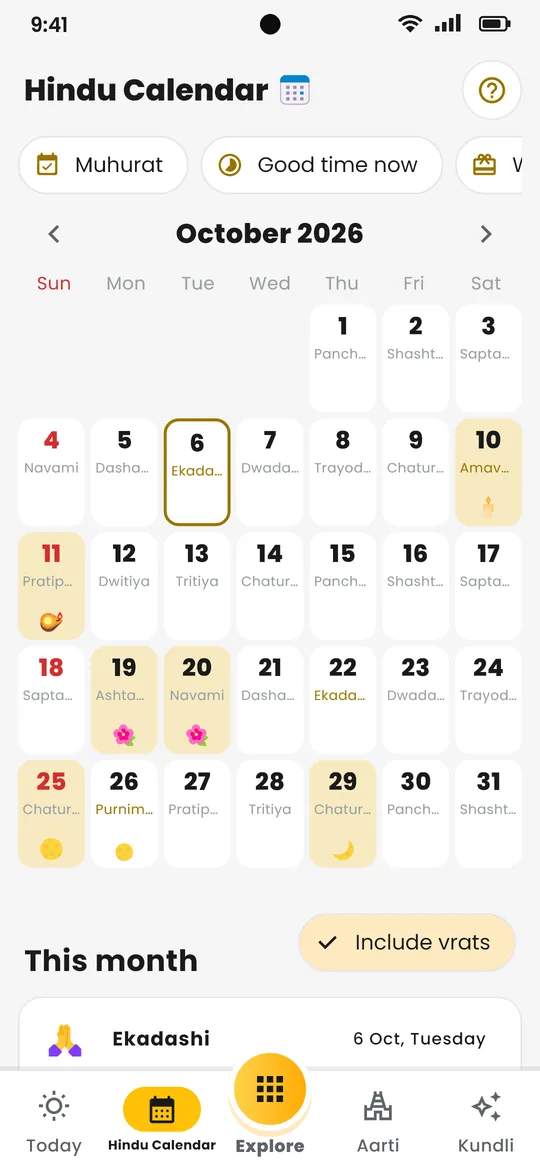
- Month view with the tithi on every date
- All major festivals and vrats, with a page for each
- Reminder the evening before each vrat or festival
- Quick access to Shubh Muhurat and Abhi Shubh Samay
- Dates calculated for your own city
How to use it
- Open Hindu CalendarIt is a tab at the bottom of the app.
- Tap any dateSee its tithi and any vrat or festival.
- Turn on remindersPick which vrats you keep.
What the Hindu calendar is and why it differs from the English calendar
The Hindu calendar is lunisolar: its months are counted by the Moon, but its year is kept close to the Sun. The English (Gregorian) calendar only follows the Sun, so a Hindu festival moves by 10 to 20 days from one English year to the next. Diwali, for example, falls on 8 November in 2026 and on 29 October in 2027.
In everyday Hindi this calendar is called the Panchang or Panchangam. The word means "five limbs", because every day is described by five parts: tithi, vaar, nakshatra, yoga and karana. A printed Panchang or the aaj ka Panchang screen gives all five for each sunrise.
The five limbs of a day
- Tithi (lunar day): one of 30 steps in the Moon's cycle. This is the limb that fixes almost every vrat and festival.
- Vaar (weekday): the seven days named after Surya, Chandra, Mangal, Budh, Guru, Shukra and Shani. The Hindu day runs from sunrise to the next sunrise, not midnight to midnight.
- Nakshatra (lunar mansion): which of the 27 star groups the Moon is passing through.
- Yoga: one of 27 combinations made by adding the Sun's and Moon's longitudes.
- Karana: half of a tithi, so there are 60 in a lunar month and 11 different names.
Because the day starts at sunrise, a tithi that begins at 10 in the morning on an English date is usually counted for the next sunrise. This one rule explains most "why is the vrat tomorrow when the tithi starts today" questions.
Hindu festivals 2026
Dates for New Delhi, calculated by the AstroMilan engine with the classical rule for each festival (the tithi at sunrise, midday, pradosh, midnight or moonrise). Tap a festival for its katha and puja vidhi.
| Date | Day | Festival | Hindi |
|---|---|---|---|
| 13 January | Tue | Lohri | लोहड़ी |
| 14 January | Wed | Makar Sankranti / Pongal | मकर संक्रांति / पोंगल |
| 23 January | Fri | Vasant Panchami | वसंत पंचमी |
| 15 February | Sun | Maha Shivratri | महाशिवरात्रि |
| 2 March | Mon | Holika Dahan | होलिका दहन |
| 4 March | Wed | Holi | होली |
| 19 March | Thu | Chaitra Navratri / Ugadi | चैत्र नवरात्रि / गुड़ी पड़वा |
| 26 March | Thu | Ram Navami | राम नवमी |
| 2 April | Thu | Hanuman Jayanti | हनुमान जयंती |
| 14 April | Tue | Baisakhi | बैसाखी |
| 20 April | Mon | Akshaya Tritiya | अक्षय तृतीया |
| 1 May | Fri | Buddha Purnima | बुद्ध पूर्णिमा |
| 16 May | Sat | Vat Savitri Vrat | वट सावित्री व्रत |
| 29 July | Wed | Guru Purnima | गुरु पूर्णिमा |
| 15 August | Sat | Hariyali Teej | हरियाली तीज |
| 17 August | Mon | Nag Panchami | नाग पंचमी |
| 28 August | Fri | Raksha Bandhan | रक्षा बंधन |
| 3 September | Thu | Krishna Janmashtami | कृष्ण जन्माष्टमी |
| 14 September | Mon | Ganesh Chaturthi | गणेश चतुर्थी |
| 14 September | Mon | Hartalika Teej | हरतालिका तीज |
| 25 September | Fri | Anant Chaturdashi | अनंत चतुर्दशी |
| 27 September | Sun | Pitru Paksha begins | पितृ पक्ष आरंभ |
| 10 October | Sat | Sarva Pitru Amavasya | सर्व पितृ अमावस्या |
| 11 October | Sun | Sharad Navratri begins | शारदीय नवरात्रि / घटस्थापना |
| 19 October | Mon | Durga Ashtami | दुर्गा अष्टमी |
| 20 October | Tue | Maha Navami | महा नवमी |
| 20 October | Tue | Dussehra | दशहरा |
| 25 October | Sun | Sharad Purnima | शरद पूर्णिमा |
| 29 October | Thu | Karva Chauth | करवा चौथ |
| 1 November | Sun | Ahoi Ashtami | अहोई अष्टमी |
| 6 November | Fri | Dhanteras | धनतेरस |
| 8 November | Sun | Diwali / Lakshmi Puja | दीपावली / लक्ष्मी पूजा |
| 8 November | Sun | Narak Chaturdashi | नरक चतुर्दशी / छोटी दिवाली |
| 10 November | Tue | Bhai Dooj | भाई दूज |
| 10 November | Tue | Govardhan Puja | गोवर्धन पूजा |
| 15 November | Sun | Chhath Puja | छठ पूजा (संध्या अर्घ्य) |
| 20 November | Fri | Dev Uthani Ekadashi | देवउठनी एकादशी |
| 24 November | Tue | Kartik Purnima / Guru Nanak Jayanti | कार्तिक पूर्णिमा / गुरु नानक जयंती |
| 14 December | Mon | Vivah Panchami | विवाह पंचमी |
| 20 December | Sun | Gita Jayanti | गीता जयंती |
Hindu festivals 2027
| Date | Day | Festival | Hindi |
|---|---|---|---|
| 14 January | Thu | Lohri | लोहड़ी |
| 15 January | Fri | Makar Sankranti / Pongal | मकर संक्रांति / पोंगल |
| 11 February | Thu | Vasant Panchami | वसंत पंचमी |
| 6 March | Sat | Maha Shivratri | महाशिवरात्रि |
| 21 March | Sun | Holika Dahan | होलिका दहन |
| 23 March | Tue | Holi | होली |
| 7 April | Wed | Chaitra Navratri / Ugadi | चैत्र नवरात्रि / गुड़ी पड़वा |
| 14 April | Wed | Baisakhi | बैसाखी |
| 15 April | Thu | Ram Navami | राम नवमी |
| 20 April | Tue | Hanuman Jayanti | हनुमान जयंती |
| 9 May | Sun | Akshaya Tritiya | अक्षय तृतीया |
| 20 May | Thu | Buddha Purnima | बुद्ध पूर्णिमा |
| 4 June | Fri | Vat Savitri Vrat | वट सावित्री व्रत |
| 18 July | Sun | Guru Purnima | गुरु पूर्णिमा |
| 4 August | Wed | Hariyali Teej | हरियाली तीज |
| 6 August | Fri | Nag Panchami | नाग पंचमी |
| 17 August | Tue | Raksha Bandhan | रक्षा बंधन |
| 24 August | Tue | Krishna Janmashtami | कृष्ण जन्माष्टमी |
| 3 September | Fri | Hartalika Teej | हरतालिका तीज |
| 4 September | Sat | Ganesh Chaturthi | गणेश चतुर्थी |
| 14 September | Tue | Anant Chaturdashi | अनंत चतुर्दशी |
| 16 September | Thu | Pitru Paksha begins | पितृ पक्ष आरंभ |
| 29 September | Wed | Sarva Pitru Amavasya | सर्व पितृ अमावस्या |
| 30 September | Thu | Sharad Navratri begins | शारदीय नवरात्रि / घटस्थापना |
| 7 October | Thu | Durga Ashtami | दुर्गा अष्टमी |
| 9 October | Sat | Maha Navami | महा नवमी |
| 9 October | Sat | Dussehra | दशहरा |
| 15 October | Fri | Sharad Purnima | शरद पूर्णिमा |
| 18 October | Mon | Karva Chauth | करवा चौथ |
| 22 October | Fri | Ahoi Ashtami | अहोई अष्टमी |
| 27 October | Wed | Dhanteras | धनतेरस |
| 28 October | Thu | Narak Chaturdashi | नरक चतुर्दशी / छोटी दिवाली |
| 29 October | Fri | Diwali / Lakshmi Puja | दीपावली / लक्ष्मी पूजा |
| 30 October | Sat | Govardhan Puja | गोवर्धन पूजा |
| 31 October | Sun | Bhai Dooj | भाई दूज |
| 4 November | Thu | Chhath Puja | छठ पूजा (संध्या अर्घ्य) |
| 10 November | Wed | Dev Uthani Ekadashi | देवउठनी एकादशी |
| 14 November | Sun | Kartik Purnima / Guru Nanak Jayanti | कार्तिक पूर्णिमा / गुरु नानक जयंती |
| 3 December | Fri | Vivah Panchami | विवाह पंचमी |
| 9 December | Thu | Gita Jayanti | गीता जयंती |
Monthly vrats
These come every month. Each page lists every date of the year.
- Ekadashi 2026: 24 dates
- Pradosh Vrat 2026: 25 dates
- Purnima 2026: 13 dates
- Amavasya 2026: 12 dates
- Sankashti Chaturthi 2026: 13 dates
- Ekadashi 2027: 25 dates
- Pradosh Vrat 2027: 25 dates
- Purnima 2027: 12 dates
- Amavasya 2027: 13 dates
- Sankashti Chaturthi 2027: 12 dates
A note on dates
A festival can fall a day apart between cities when its tithi begins or ends close to the deciding time. The app calculates for your own city, and regional traditions may follow a different rule. If your family follows a local panchang, go by it.
Tithi: the lunar day that decides every vrat
A tithi is the time the Moon takes to move 12 degrees ahead of the Sun. Thirty tithis make 360 degrees, which is one full lunar month from new moon to new moon, about 29.5 days. Since the Moon's speed changes along its orbit, a tithi can last anywhere from about 19 hours to about 26 hours.
This uneven length creates two special cases. When a tithi starts after one sunrise and ends before the next, no sunrise touches it, so it is called a kshaya tithi (lost tithi) and is skipped in the daily list. When a tithi covers two sunrises, it is a vriddhi tithi (extended tithi) and appears on two days. The festival is then placed by the rule for that festival, which we explain further down.
The 15 tithis of each paksha
| No. | Tithi | Group | Common vrat or observance |
|---|---|---|---|
| 1 | Pratipada | Nanda | Start of Navratri (Shukla), new year in many regions |
| 2 | Dwitiya | Bhadra | Bhai Dooj (Kartik Shukla) |
| 3 | Tritiya | Jaya | Teej vrats, Akshaya Tritiya |
| 4 | Chaturthi | Rikta | Vinayaka Chaturthi (Shukla), Sankashti Chaturthi (Krishna) |
| 5 | Panchami | Purna | Nag Panchami, Vasant Panchami, Vivah Panchami |
| 6 | Shashthi | Nanda | Skanda Shashthi, Chhath (Kartik Shukla) |
| 7 | Saptami | Bhadra | Ratha Saptami for Surya |
| 8 | Ashtami | Jaya | Durga Ashtami, Janmashtami, Ahoi Ashtami |
| 9 | Navami | Rikta | Ram Navami, Maha Navami |
| 10 | Dashami | Purna | Dussehra (Vijayadashami) |
| 11 | Ekadashi | Nanda | Ekadashi fast for Vishnu, twice a month |
| 12 | Dwadashi | Bhadra | Parana (breaking) of the Ekadashi fast |
| 13 | Trayodashi | Jaya | Pradosh Vrat for Shiva, twice a month |
| 14 | Chaturdashi | Rikta | Masik Shivratri, Mahashivratri, Narak Chaturdashi |
| 15 | Purnima / Amavasya | Purna | Full moon vrat or new moon tarpan |
The five groups (Nanda, Bhadra, Jaya, Rikta and Purna) are used in muhurat work. Rikta tithis (4, 9 and 14) are traditionally avoided for starting new work such as a shop opening or griha pravesh, which is why the shubh muhurat finder skips them for those events.
Paksha: Shukla and Krishna fortnights
Each lunar month has two pakshas (fortnights) of 15 tithis each. Shukla Paksha is the bright, waxing half that runs from the day after Amavasya (new moon) up to Purnima (full moon). Krishna Paksha is the dark, waning half that runs from the day after Purnima down to Amavasya.
A Hindu date is always written as month, paksha and tithi. "Kartik Krishna Amavasya" is Diwali. "Bhadrapad Shukla Chaturthi" is Ganesh Chaturthi. "Ashwin Shukla Dashami" is Dussehra. Once you can read this format, any Panchang becomes easy.
Why the paksha matters for vrats
Many observances come twice a month, once in each paksha, and they are named apart. Ekadashi comes as Shukla Ekadashi and Krishna Ekadashi, each with its own name such as Devshayani or Dev Uthani. Chaturthi comes as Vinayaka Chaturthi in Shukla Paksha and Sankashti Chaturthi in Krishna Paksha. Pradosh Vrat falls on both Trayodashis.
Traditionally, Shukla Paksha is preferred for beginnings such as engagements, naamkaran and griha pravesh, because the Moon is gaining light. Krishna Paksha holds many vrats for protection and for the ancestors, including the whole of Pitru Paksha.
The 12 Hindu months and the festivals in each
Each Hindu month takes its name from the nakshatra near which the Moon is full in that month. Chaitra is named after Chitra nakshatra, Kartik after Krittika, Magh after Magha, and so on. The table gives the usual English months and the main festivals; exact dates shift every year.
| Hindu month | Roughly falls in | Purnima nakshatra | Main festivals and vrats |
|---|---|---|---|
| Chaitra | March to April | Chitra | Chaitra Navratri, Gudi Padwa, Ugadi, Ram Navami, Hanuman Jayanti |
| Vaishakh | April to May | Vishakha | Akshaya Tritiya, Buddha Purnima |
| Jyeshtha | May to June | Jyeshtha | Vat Savitri Vrat, Ganga Dussehra, Nirjala Ekadashi |
| Ashadh | June to July | Purva Ashadha | Rath Yatra, Devshayani Ekadashi, Guru Purnima |
| Shravan | July to August | Shravana | Shravan Somvar, Hariyali Teej, Nag Panchami, Raksha Bandhan |
| Bhadrapad | August to September | Purva Bhadrapada | Janmashtami, Hartalika Teej, Ganesh Chaturthi, Anant Chaturdashi |
| Ashwin | September to October | Ashwini | Pitru Paksha, Sharad Navratri, Dussehra, Sharad Purnima |
| Kartik | October to November | Krittika | Karva Chauth, Dhanteras, Diwali, Bhai Dooj, Chhath, Dev Uthani Ekadashi |
| Margashirsha | November to December | Mrigashira | Vivah Panchami, Gita Jayanti |
| Paush | December to January | Pushya | Paush Putrada Ekadashi; Makar Sankranti often falls here or in Magh |
| Magh | January to February | Magha | Mauni Amavasya, Vasant Panchami, Magh Purnima |
| Phalgun | February to March | Purva Phalguni | Mahashivratri, Holika Dahan, Holi |
Festivals in the Krishna Paksha column of this table follow the North Indian (Purnimanta) month names. In Maharashtra, Gujarat and the South, the same day carries the previous month's name. The next section explains why.
Amanta vs Purnimanta: two ways to end a month
India uses two systems for where a lunar month ends. In the Amanta system the month ends on Amavasya, so it starts with Shukla Paksha. In the Purnimanta system the month ends on Purnima, so it starts with Krishna Paksha. Both systems agree on every tithi and every festival date; only the month label for Krishna Paksha days differs.
Who uses which system
- Purnimanta: most of North and Central India, including Uttar Pradesh, Bihar, Madhya Pradesh, Rajasthan, Delhi, Haryana, Punjab, Himachal Pradesh, Uttarakhand, Jharkhand and Chhattisgarh.
- Amanta: Maharashtra, Gujarat, Goa, Karnataka, Andhra Pradesh and Telangana.
- Solar calendars: Tamil Nadu, Kerala, West Bengal, Odisha, Assam and Punjab also keep solar months that start at each sankranti, while still following tithis for vrats.
An example that confuses many families
Janmashtami falls on Krishna Ashtami. A family in Lucknow calls it Bhadrapad Krishna Ashtami. A family in Pune calls it Shravan Krishna Ashtami. They are fasting on the same day; the Pune calendar simply has not yet moved to Bhadrapad because its month changes at the next Amavasya. Mahashivratri works the same way: Phalgun Krishna Chaturdashi in the North and Magh Krishna Chaturdashi in Amanta regions.
So when a relative in another state quotes a different month for the same vrat, check the paksha. If it is Krishna Paksha, both are right.
Adhik Maas: the extra month that keeps festivals in season
Twelve lunar months add up to about 354 days, roughly 11 days short of the solar year of about 365 days. Without a correction, Diwali would slowly drift from autumn into summer and then into the monsoon. The Hindu calendar fixes this by adding an extra lunar month, called Adhik Maas, Purushottam Maas or Mal Maas, about once every 32 to 33 months.
How the extra month is chosen
The rule is based on sankranti, the moment the Sun enters a new sidereal rashi. A normal lunar month contains one sankranti. If a lunar month passes with no sankranti in it, that month is declared Adhik and the next month with the same name is the regular one. Very rarely a lunar month contains two sankrantis, and then a month is dropped as Kshaya Maas; this happens only a few times in a century.
Adhik Maas in 2026
2026 has an Adhik Jyeshtha. You can see it in the dates: there are 13 Purnimas in 2026, including both 1 May and 31 May, and the Amavasyas of 16 May and 15 June frame the extra month. This is also why the festivals of the second half of 2026 come later than in 2025: Raksha Bandhan is on 28 August 2026 and Diwali on 8 November 2026. In 2027 there is no Adhik Maas, so festivals come about 11 days earlier again, with Raksha Bandhan on 17 August 2027 and Diwali on 29 October 2027.
Traditionally Adhik Maas is not used for weddings, griha pravesh, mundan or other new beginnings. It is devoted to Vishnu, extra japa, daan, reading scripture and keeping regular vrats. Ekadashis in Adhik Maas have their own names: Padmini and Parama.
Vikram Samvat, Shaka Samvat and the Hindu new year
Hindu calendars count years in eras called samvat. The two most used are Vikram Samvat and Shaka Samvat, and they begin at different points in history and, in some regions, at different times of the year.
| Era | Starts from | How to convert | Where it is used |
|---|---|---|---|
| Vikram Samvat | 57 BCE | Add 57 to the English year after the new year (add 56 before it) | North India, Nepal, Gujarat, most Panchangs |
| Shaka Samvat | 78 CE | Subtract 78 from the English year after the new year (79 before it) | Indian National Calendar, South Indian Panchangs, Maharashtra |
When does the year change
In most of North India and in Maharashtra, Karnataka, Andhra Pradesh and Telangana, the new year begins on Chaitra Shukla Pratipada. In 2026 that day also began Chaitra Navratri, on 19 March 2026, starting Vikram Samvat 2083. It is celebrated as Gudi Padwa in Maharashtra and Ugadi in Karnataka, Andhra Pradesh and Telangana.
Gujarat begins its Vikram Samvat year on Kartik Shukla Pratipada, the day after Diwali, which is why Gujarati families wish "Saal Mubarak" with Govardhan Puja. Solar-calendar regions start the year when the Sun enters Mesha (Aries) around 14 April: Baisakhi in Punjab, Puthandu in Tamil Nadu, Vishu in Kerala, Pohela Boishakh in Bengal and Bohag Bihu in Assam.
The Indian National Calendar, adopted in 1957, uses Shaka years but solar months. Its 1 Chaitra falls on 22 March in a normal year. It is used for government gazettes and is different from the lunar Shaka dates in a traditional Panchang.
How festival dates are decided
A festival is defined as a tithi in a month, but a tithi does not line up with a calendar day. So each festival also has a rule about which part of the day the tithi must cover. This is called the karmakaal (time of the ritual), and it explains why two festivals that look alike follow different dates.
The main rules
| Rule | The tithi must be present at | Festivals that follow it |
|---|---|---|
| Udaya tithi | Sunrise | Most vrats, Ekadashi, Akshaya Tritiya, Navratri start, Raksha Bandhan (outside Bhadra) |
| Madhyahna | Midday | Ganesh Chaturthi, Ram Navami |
| Pradosh kaal | About 1.5 hours after sunset | Diwali Lakshmi Puja, Pradosh Vrat, Holika Dahan, Dhanteras puja |
| Nishita kaal | Around midnight | Janmashtami, Mahashivratri, Kali Puja |
| Moonrise | Moonrise | Karva Chauth, Sankashti Chaturthi |
| Sankranti | The Sun's entry into a rashi | Makar Sankranti, Baisakhi, Lohri (eve) |
Diwali 2026 is a good example. The Amavasya tithi covers Pradosh kaal on the evening of 8 November 2026, so Lakshmi Puja is that night, and the Chaturdashi rituals of Narak Chaturdashi fall early that same morning. Govardhan Puja and Bhai Dooj both land on 10 November 2026 because of how Pratipada and Dwitiya fall at sunrise that year.
Why your city can show a different date
Sunrise, sunset, midnight and moonrise all depend on your location. When a tithi changes close to sunrise, a city in the east such as Kolkata can see a different udaya tithi from a city in the west such as Ahmedabad. Karva Chauth and Sankashti depend on moonrise, which can differ by over half an hour across India. That is why AstroMilan works out dates for the place you save, not one national time.
Smarta and Vaishnava dates
Ekadashi and Janmashtami sometimes have two listed dates. Smarta families follow the plain tithi rule. Vaishnava traditions, such as ISKCON, avoid an Ekadashi that is touched by Dashami at the start of the day and fast the next day instead. Neither is wrong; follow your family or sampradaya.
The monthly vrats every family keeps track of
Apart from the big festivals, a few vrats come every month. Most Hindu calendars mark them, and many families keep at least one of them regularly. Here is what each one is and how often it comes.
| Vrat | Tithi | Times a month | Deity | Key time |
|---|---|---|---|---|
| Ekadashi | 11th of both pakshas | 2 | Vishnu | Fast from sunrise, parana on Dwadashi morning |
| Pradosh Vrat | 13th of both pakshas | 2 | Shiva | Puja in Pradosh kaal after sunset |
| Sankashti Chaturthi | Krishna Chaturthi | 1 | Ganesha | Fast ends after seeing the Moon |
| Purnima | Full moon | 1 | Vishnu (Satyanarayan), Chandra | Katha, snan and daan |
| Amavasya | New moon | 1 | Pitru (ancestors) | Tarpan and daan, usually in the morning |
A normal year therefore has about 24 Ekadashis, 24 Pradosh Vrats, 12 Sankashti Chaturthis, 12 Purnimas and 12 Amavasyas. A year with Adhik Maas has two more of each paired vrat and one more of the others, which is why 2026 shows 13 Purnimas.
Special names within the monthly vrats
- Pradosh by weekday: a Pradosh on Monday is Som Pradosh, on Tuesday Bhaum Pradosh and on Saturday Shani Pradosh. Each is said to carry a special benefit.
- Sankashti on Tuesday: called Angaraki Chaturthi, especially popular in Maharashtra.
- Amavasya on Monday: Somvati Amavasya, a big day for snan and for married women's vrats in the North.
- Named Ekadashis: Nirjala in Jyeshtha, Devshayani in Ashadh, Dev Uthani in Kartik and Mokshada in Margashirsha are the most widely kept.
Weekly vrats such as Somvar for Shiva, Mangalvar for Hanuman and Shukravar for Santoshi Mata follow the weekday, not the tithi. Their kathas are in vrat katha, and the aarti for each day is in aarti and chalisa.
Common mistakes when reading a Hindu calendar
Most date confusion comes from a handful of habits. Knowing them saves a lot of last-minute calls to relatives.
- Using the tithi start time instead of the sunrise rule. If Ekadashi starts at 2 pm on Monday, the fast is normally on Tuesday, because Tuesday's sunrise falls in Ekadashi.
- Copying a date from a calendar printed for another city. A wall calendar from Varanasi can be a day off for Bengaluru on a few vrats a year. Moonrise festivals differ most.
- Mixing up Amanta and Purnimanta month names. Check the paksha before deciding someone is wrong.
- Forgetting Adhik Maas. In an Adhik year, "Jyeshtha Purnima" can mean two different dates. Panchangs mark the extra month as Adhik or Purushottam.
- Ignoring Bhadra on Raksha Bandhan and Holika Dahan. Both are traditionally done outside Bhadra (Vishti karana), so the timing can move to the afternoon or evening.
- Treating Makar Sankranti as a tithi festival. It is a solar event, so it stays near 14 or 15 January every year: 14 January 2026 and 15 January 2027.
Festival dates are a matter of tradition. When your family pandit or temple follows a different rule, their guidance for your household should come first.
Using the Hindu calendar in the AstroMilan app
Hindu Calendar is a tab at the bottom of the AstroMilan app. The month view shows the tithi on every date, with all major festivals and monthly vrats marked. Tap any date to see its tithi and any vrat or festival, and open that festival's page for the katha, puja vidhi and puja time.
- Open the Hindu Calendar tab and pick a month.
- Tap a date to see its tithi and observance.
- Turn on reminders and choose the vrats you keep. The app reminds you the evening before.
The calendar links straight to the Shubh Muhurat finder and to Abhi Shubh Samay, which shows the live Choghadiya. Eclipses for next year are on the Grahan 2027 screen, and the full list of festival pages is on the festivals page. Dates are calculated for your own city using Lahiri ayanamsa, and the calendar works offline.
Privacy note
There is no login. Your saved city and reminder choices stay on your phone, and reminders are scheduled on the device. AstroMilan is free with ads from Google AdMob and sends anonymous usage counts and crash reports to Google Firebase, which never include your personal details. Read more on the privacy page.
Questions people ask
How many months are there in the Hindu calendar?
There are 12 lunar months: Chaitra, Vaishakh, Jyeshtha, Ashadh, Shravan, Bhadrapad, Ashwin, Kartik, Margashirsha, Paush, Magh and Phalgun. Each is named after the nakshatra near which the Moon is full. About every 32 to 33 months an extra month, Adhik Maas, is added, so that year has 13 lunar months. 2026 has an Adhik Jyeshtha.
What is a tithi in simple words?
A tithi is a lunar day: the time the Moon takes to move 12 degrees ahead of the Sun. There are 30 tithis in a lunar month, 15 in Shukla Paksha and 15 in Krishna Paksha. A tithi lasts roughly 19 to 26 hours, so it rarely matches a calendar day. Vrats are set by the tithi at sunrise or at a set ritual time.
What is the difference between Amanta and Purnimanta?
In the Amanta system a month ends on Amavasya; in the Purnimanta system it ends on Purnima. North India mostly follows Purnimanta, while Maharashtra, Gujarat, Karnataka, Andhra Pradesh and Telangana follow Amanta. Festival dates are the same in both. Only the month name for Krishna Paksha days differs by one month.
Why does Diwali fall on a different date every year?
Diwali is fixed to Kartik Amavasya, a lunar date. Twelve lunar months are about 11 days shorter than a solar year, so the festival moves earlier each year until an Adhik Maas pushes it later again. That is why it is on 8 November in 2026, after an Adhik Maas, and on 29 October in 2027. See the Diwali page for puja time.
When is Adhik Maas in 2026?
2026 has an Adhik Jyeshtha month. It runs between the Amavasya of 16 May 2026 and the Amavasya of 15 June 2026, which is why 2026 has two Purnimas in May. Weddings, griha pravesh and other new beginnings are traditionally avoided in this month, while japa, daan and Vishnu puja are encouraged.
Which Vikram Samvat year is it now?
Vikram Samvat 2083 began on Chaitra Shukla Pratipada, 19 March 2026, in the North Indian reckoning. To convert, add 57 to the English year after the Hindu new year. In Gujarat, the Vikram Samvat year changes on the day after Diwali instead, so the number changes later in the year there.
How many Ekadashis are there in a year?
A normal year has 24 Ekadashis, two in each lunar month, one in each paksha. In a year with Adhik Maas there are 26. Each Ekadashi has its own name and katha, such as Nirjala, Devshayani and Dev Uthani. See all upcoming dates on the Ekadashi dates page.
Why does my calendar show a vrat on a different day than my relative's calendar?
There are three usual reasons. The calendars may be calculated for different cities, so sunrise or moonrise differs. One may follow the Smarta rule and the other the Vaishnava rule, which happens with Ekadashi and Janmashtami. Or they may use different month names under Amanta and Purnimanta. Check the tithi and paksha first.
Is the Hindu calendar the same as the Panchang?
Mostly, yes. The Panchang is the detailed daily almanac with tithi, vaar, nakshatra, yoga and karana, plus sunrise, Rahu Kaal and muhurat times. The Hindu calendar is the month-by-month view of the same data with festivals marked. Today's full Panchang is on the aaj ka Panchang page.
Does AstroMilan remind me before a vrat?
Yes. In the Hindu Calendar tab, turn on reminders and pick the vrats you keep, such as Ekadashi, Pradosh or Purnima. The app reminds you the evening before. Reminders are scheduled on your phone, so they work without an account, and you can switch them off any time in Settings.
Everything in one free app
Kundli Milan, Panchang, Rashifal, Hindu Calendar, Aarti and 20 more tools. No login, and your details never leave your phone.
